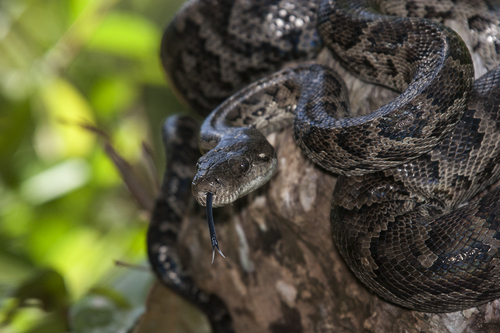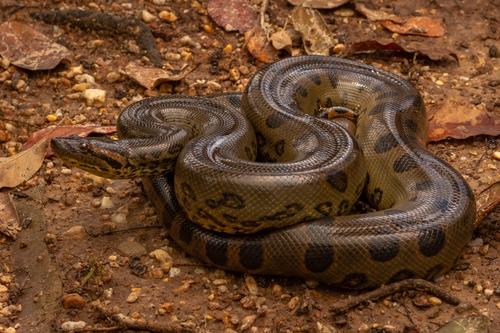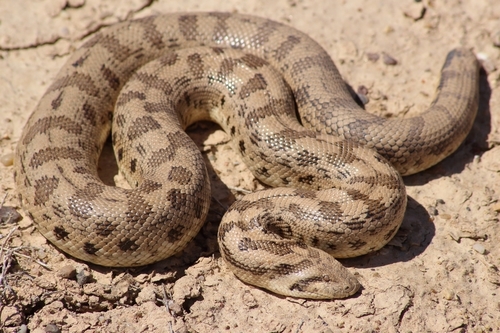
About Eryx miliaris (Pallas, 1773)
Species Common Name and General Build
Eryx miliaris, commonly known as the desert sand boa, is a stout sand boa species with a consistent set of physical traits across recorded populations.
Adult Standard Body Length
According to the WCH-University of Adelaide, adult E. miliaris usually reach 30 centimeters in length, with a maximum recorded length of approximately 90 centimeters.
Sexual Size Dimorphism
Other sources confirm that like most sand boas, female E. miliaris are larger than males.
Length If E. tataricus Synonymized
If E. tataricus (the Tartar sand boa) is accepted as a synonym of E. miliaris, E. tataricus represents the larger variant of the species: adult male Tartar sand boas rarely reach 75 centimeters, while adult females can reach 120 centimeters.
General Body Morphology
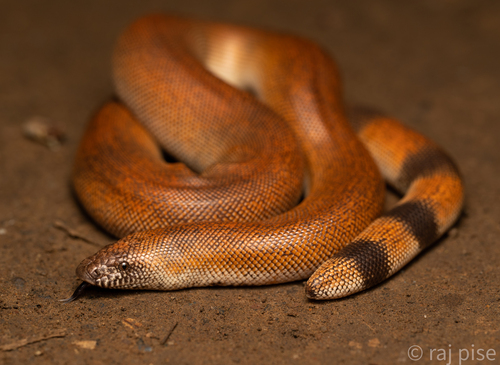
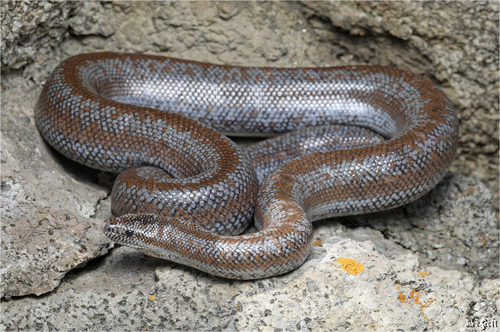
E. miliaris is a small, stout, cylindrical-bodied snake relative to other snake species.
Head and Tail Morphology
It has a very short, thick, blunt tail, a head that is not distinctly separated from its neck, and a snout that is rounded from above and pointed and projecting from the side.
Eye Characteristics
Its eyes are small, positioned on the dorsal side of the head, and have vertically elliptical pupils.
Scale and Body Texture
Dorsal scales are smooth to weakly keeled, and the overall body is strong and round.
Coloration
Scale coloration is a mixture of brown, red, and black that fades to white on both sides of the body.
Broad Habitat Range
This species occupies arid and semi-arid habitats across a broad range in Southern Asia, Europe, and Northern Asia.
WCH Elevation and Habitat Record
WCH-University of Adelaide records it occurring at elevations up to around 2700 meters above mean sea level, primarily in arid and semi-arid sandy regions with bush vegetation, though it can also tolerate harder soils and rocky slope terrain.
IUCN Elevation Record for E. miliaris
The IUCN records E. miliaris occurring from sea level up to approximately 1200 meters above sea level.
Elevation for E. tataricus Taxa
When E. tataricus is treated as a separate population or species, IUCN notes that E. tataricus in Mongolia occurs at elevations from 80 to 1600 meters, and the putative subspecies E. tataricus vittatus occurs at elevations from 700 to 1400 meters.
Taxonomic Distribution Disagreement Cause
Multiple taxonomic databases have recorded the geographic distribution of this species, with some minor disagreements tied to whether E. tataricus is treated as a separate species or a synonym of E. miliaris.
RDB Core Range for E. miliaris Sensu Stricto
The Reptile Database (RDB) describes the core range of E. miliaris sensu stricto as covering all of Iraq, Kazakhstan, Uzbekistan, Turkmenistan, and Afghanistan; southern Russia from the Caspian Sea to the Kazakhstan border; China from Xinjiang through Gansu and Ningxia to Inner Mongolia; and Mongolia.
RDB Recognized Subspecies
RDB also recognizes the subspecies E. miliaris nogaiorum (alongside the nominate subspecies E. miliaris miliaris), found in the Nogai Steppe of Russian Chechnya between the Terek and Kuma rivers, based on early 20th century records from Nikolsky.
IUCN Range Comparison to RDB
IUCN matches RDB’s range information for China, Afghanistan, Kazakhstan, Uzbekistan, and Turkmenistan, but describes the Russian range as eastern Ciscaucasia including Chechnya, Dagestan, and Kalmykia, omits Iraq, and adds northern Iran.
IUCN Mongolian Record Status
IUCN also considers E. miliaris presence in Mongolia uncertain due to conflicting reports, and refers to Mongolian Eryx records as part of an "Eryx miliaris-tataricus complex", with many authors attributing all Mongolian Eryx records to E. tataricus, which RDB considers an invalid synonym of E. miliaris.
RDB E. tataricus Range Description
RDB notes that the range of the invalid synonym E. tataricus overlaps the range of E. miliaris, extending from Iran through western Pakistan into Afghanistan, Tajikistan, Kyrgyzstan, eastern Kazakhstan, eastern Uzbekistan, and eastern Turkmenistan, and covering the same regions of China and southern Mongolia that E. miliaris is recorded from, with the type locality listed as Tataria.
IUCN E. tataricus Range Description
IUCN matches RDB’s description of E. tataricus range in southern Mongolia and China, and notes E. tataricus occurs in northern and central Iran, extending south through Afghanistan into northwestern Baluchistan, Pakistan, and across all five Central Asian countries, with the Caspian Sea as the western range boundary.
E. speciosus Taxonomic Treatment
RDB treats E. speciosus as another invalid synonym of E. tataricus with a range overlapping E. tataricus in Pakistan and the Vakhsh River valley of Tajikistan, while IUCN treats E. speciosus as a restricted-range subspecies of E. tataricus limited to roughly 200 km2 in Tajikistan.
ITIS Distribution Summary
The Integrated Taxonomic Information System (ITIS) summarizes the overall distribution by assigning E. miliaris to Southern Asia, Europe, and Northern Asia, excluding China.