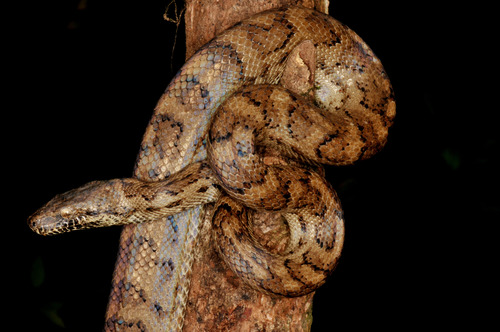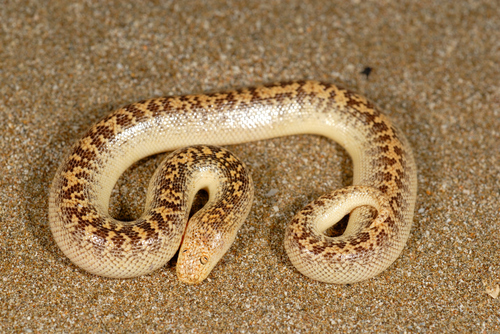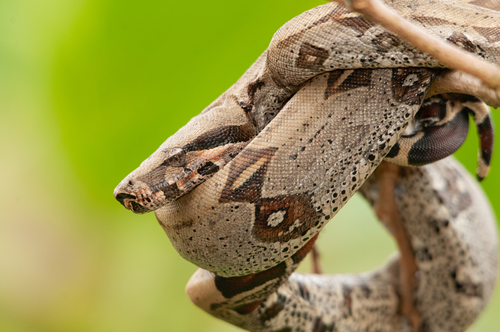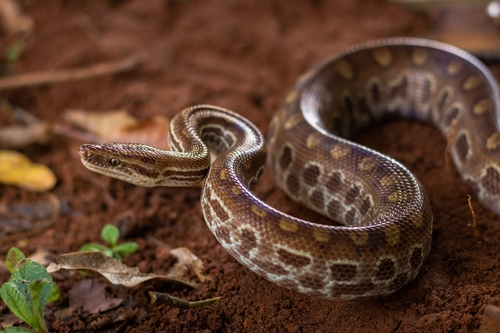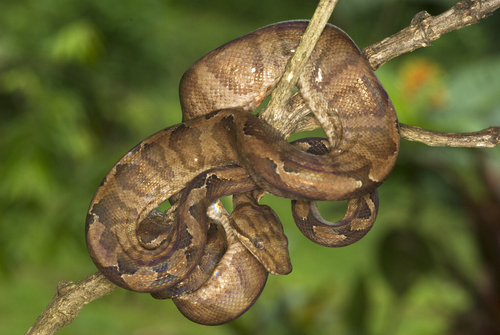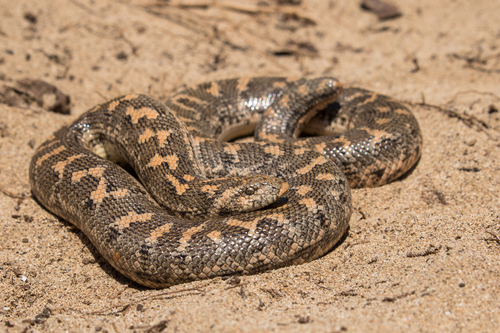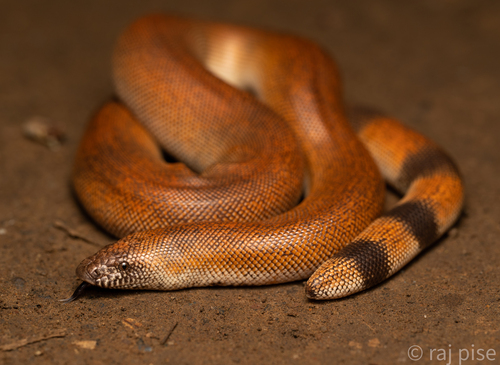
About Eryx johnii (Russell, 1801)
Adult Size
Adults of Eryx johnii rarely reach a total length (including the tail) of over 2 feet (61 cm), though they may occasionally grow as long as 3 feet (91 cm).
Burrowing Adaptations
This species is adapted for burrowing, with a wedge-shaped head, narrow nostrils, and very small eyes.
Body Structure
Its body is cylindrical, covered in small, polished dorsal scales.
Tail Morphology
The tail is blunt, rounded, not sharply distinct from the body, and gives a truncated appearance.
Coloration
The species' coloration ranges from reddish brown to dull yellow-tan.
Geographic Range
Eryx johnii occurs geographically from Iran, through Pakistan, into western, southern, and northwestern India.
Type Locality
Its recorded type locality is "Tranquebar", which corresponds to Tanjore, Trichy, in southeastern Tamil Nadu, India.
Regional Distribution & Common Name
It is also found in the Indian desert, and in the western Indian state of Maharashtra, it is called the Mandul snake in the Marathi language.
Habitat Elevation
This species inhabits dry, semi-desert scrub plains and rocky dry foothills, up to an elevation of 200 m (660 ft).
Substrate Preference
It prefers loose sand or easily crumbled sandy soil, burrows into this substrate, and lives underground.
Reproduction
Eryx johnii is ovoviviparous; females give birth to as many as 14 young at a time, between late summer and the monsoon season.