About Homopus femoralis Boulenger, 1888
Species Common Name and Genus Status
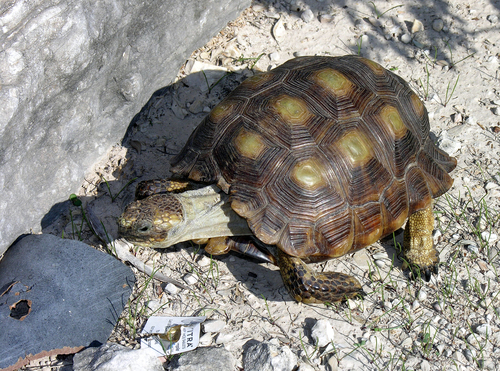
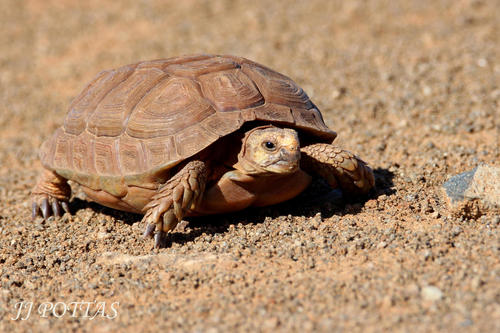
Homopus femoralis, commonly known as the greater padloper, is the largest species in the Homopus (padloper) genus of tortoises, but it remains a very small species overall.
Adult Size and Sexual Size Dimorphism
Adults average slightly over 10 cm in length, and males are typically smaller than females.
Buttock Tubercles
This species has relatively large buttock tubercles.
Toe Count
Like its close relative H. areolatus, and unlike other padloper species, it has four toes on both its front and hind feet.
Shell Color and Shape
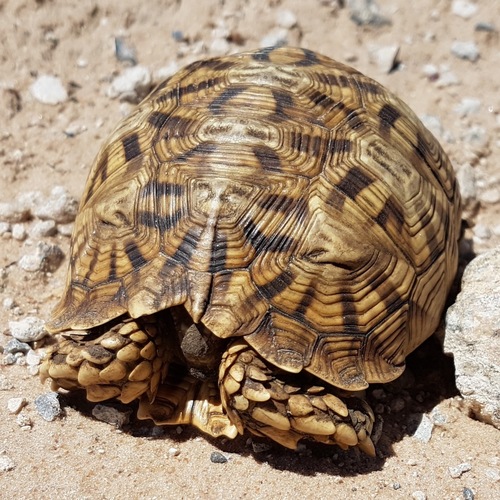
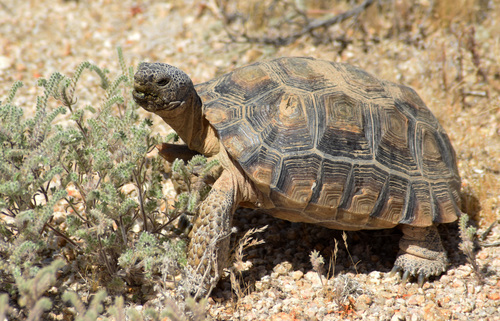
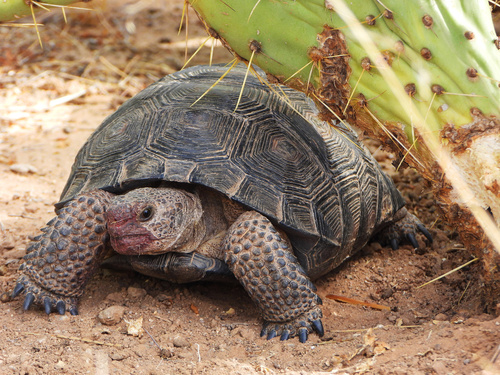
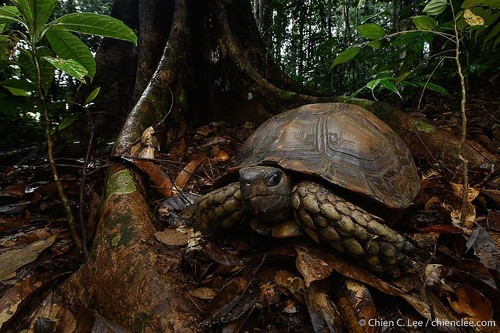
The species' shell ranges in color from olive to reddish-brown, and is slightly flattened in both sexes.
Shell Shield Markings
The shell shields are usually separated by very thin white lines. In juveniles and adult males, the shell shields typically have slightly darker edges.
Male Sexual Traits
Aside from smaller size, males can be told apart from females by their longer tails, and males do not have a plastral concavity.
Similar Sympatric Species
The greater padloper is sometimes confused with the Karoo padloper (H. boulengeri), which lives in the Karoo region to the west of the greater padloper's range.
Distinguishing Features from Karoo Padloper
The greater padloper can be distinguished from this species by its larger overall size, nostrils positioned below eye level, four toes on both front and hind feet, larger scales on the forelimbs, and the darker rings around the shell scutes that are present in many individuals.
Native Habitat Type
The greater padloper is native to the highveld plateau of southern Africa, where it primarily inhabits summer-rainfall grasslands, savanna, and bushveld.
Range Boundaries and Habitat Requirements
Its range extends north to the central Free State and east to the Lesotho border, and it is restricted to high altitude regions that receive over 250 mm of rainfall per year.
Relict Karoo Population
A sparse relict population of greater padlopers also extends into the high escarpment on the edge of the Karoo, where the climate is relatively humid.
Common Name Misnomer
Although this species has sometimes been called the Karoo cape tortoise, it is not widespread in the Karoo, unlike the Karoo padloper which is restricted to that region.
Microhabitat Preference and Population Density
As a species adapted to summer-rainfall areas, the greater padloper tends to favor rocky outcrops within its range, and its overall population is relatively sparse.
Research and Database Inclusion
The species has been little studied, but it is included in datasets like ITIS and other biological databases.