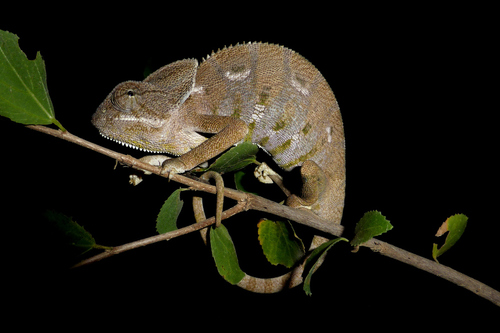
About Chamaeleo namaquensis Smith, 1831
Scientific Name and General Ecology
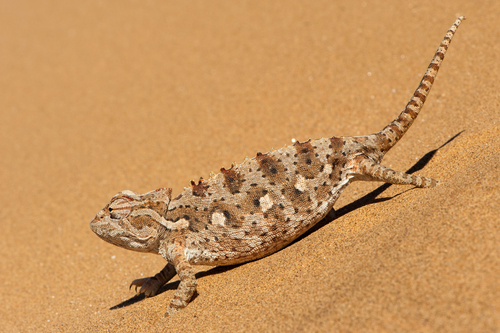
The Namaqua chameleon, with the scientific name Chamaeleo namaquensis Smith, 1831, is a ground-living lizard that lives in the western desert regions of Namibia, South Africa, and southern Angola.
Distribution Range
This chameleon species occurs naturally across the arid western part of southern Africa, and is especially common in the Namib Desert. Its recorded range extends as far south as Sutherland in the Western Cape, South Africa, and as far north as southern Angola.
Range Overlap
At the far eastern edge of its range in eastern Namibia, its natural distribution overlaps with the range of its relative, the flap-necked chameleon.
Habitat Types
Within its natural range, it lives in arid and semi-arid habitats such as Karoo shrubland, sandy desert, and gravel plains, and even forages in intertidal zones.
Terrestrial Behavior
It is a terrestrial species, most often seen moving along the ground, though young individuals are frequently found climbing.
Breeding Timing
Breeding can take place at any time of year.
Egg Gestation Period
Before laying, eggs develop inside the mother for a gestation period of 35 to 45 days.
Annual Clutch Frequency
Adult females typically lay 2 to 3 clutches of eggs per year, and may occasionally lay up to 4.
Clutch Size Range
Each clutch holds 10 to 13 eggs, though clutch size can range from as few as 6 eggs to as many as 22.
Egg Burial Substrate Requirements
Eggs are buried under loose gravel and in a layer of moist sand, because dry sand causes eggs to shrivel.
Burrow Nesting Behavior
Females will sometimes dig an extension of their existing resting burrow to lay eggs; this behavior is thought to suggest a degree of parental care for the eggs, since the parent stays in close proximity to the eggs through incubation.
Wild Nest Depth
In the wild, females dig a burrow 20 to 25 centimeters deep, and lay eggs at a depth of 15 centimeters to reach the damp sand layer.
Captive Nest Depth
In captive conditions, eggs may be buried around 10 centimeters under the substrate.
Layered Egg Laying
Females lay groups of 6 to 8 eggs in separate layers, burying one layer before laying another directly above it.
Nesting Process Duration
The entire process of excavation and egg laying takes 8 to 10 hours.
Communal Nest Covering Behavior
Unusually for chameleons, in captive settings other chameleons of either sex may help cover the nesting hole after laying is complete.
Egg Incubation Period
After being laid, eggs take approximately 100 days to hatch.
Juvenile Climbing Behavior
Like captive individuals, wild young Namaqua chameleons prefer climbing and are more skilled at it than adults.
Sexual Maturity Age
Females reach sexual maturity at 150 days old, while males reach sexual maturity at 210 days old.
Sperm Storage Ability
Like many other chameleons and lizards, female Namaqua chameleons can store sperm after a single mating, allowing them to lay more fertile eggs months later.
Post-Laying Female Physiology
Egg laying is physically taxing for females and depletes their fat reserves, so after laying they eat as much as their stomachs can hold; in captivity, females should be allowed unlimited food after laying.
Reproductive Evolution Hypothesis
Because embryos and eggs are at an unusually advanced stage of development when they are laid, it has been suggested that this species is in the process of evolving ovoviviparity.