About Chaetodon trifascialis Quoy & Gaimard, 1825
Common Name & Adult Body Markings
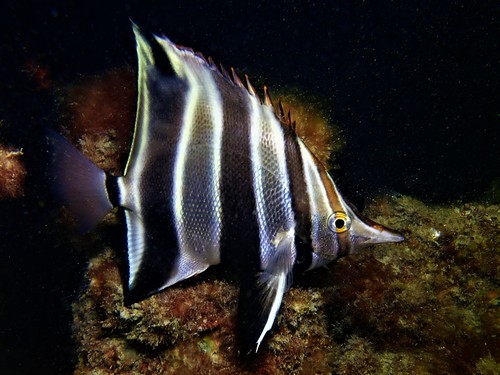
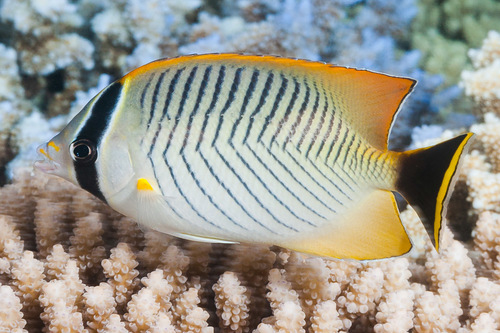
Chaetodon trifascialis Quoy & Gaimard, 1825, commonly called the chevron butterflyfish, has an elongated pale body marked with dark vertical chevron-shaped markings. It has a black tail with a yellow posterior margin, and a black band with pale edges that runs through the eye.
Juvenile Coloration
Juveniles have an extra black vertical band that runs from the rear of the dorsal fin, across the back of the body, to the rear of the anal fins; they also have a yellow tail base and yellow pectoral fins.
Fin Structure
The dorsal fin of this species holds 13 to 15 spines and 14 to 16 soft rays, while the anal fin holds 3 to 5 spines and 13 to 15 soft rays.
Maximum Length
The maximum total length this species can reach is 18 centimetres (7.1 inches).
General Distribution
The chevron butterflyfish has a wide distribution across the Indo-Pacific region. In the western Indian Ocean, it occurs along the East African coast from Egypt south to South Africa, and ranges across the entire Indian Ocean including its island groups, continuing into the Pacific Ocean as far east as the Line Islands, Johnston Atoll, and Howland and Baker Islands in the central-west Pacific.
Range Extremes
Its range extends north to southern Japan, and south to Lord Howe Island and Rapa Iti.
Western Australian Distribution
In Australia, the species is found from the Houtman Abrolhos to Beagle Reef, as well as the Rowley Shoals and Scott Reef in Western Australia.
Eastern Australian Distribution
It also occurs on the northern Great Barrier Reef off Queensland, on some reefs in the Coral Sea, and as far south as Arrawarra Headland near Coffs Harbour in New South Wales.
Australian Indian Ocean Territory Distribution
It can additionally be found around the Australian Indian Ocean territories of the Cocos (Keeling) Islands and Christmas Island.
Habitat
The chevron butterflyfish is a territorial species that lives on semi-protected seaward reefs and shallow lagoon reefs.
Diet & Coral Association
It is closely associated with tabular and staghorn Acropora corals, and feeds on the polyps and mucus of these corals.
Depth Range
It occurs at depths between 2 and 30 metres.
Social Behavior
Adults are most often found swimming alone, or in pairs particularly during the breeding season, while juveniles hide and remain secretive among coral branches.
Reproduction
This species is oviparous.