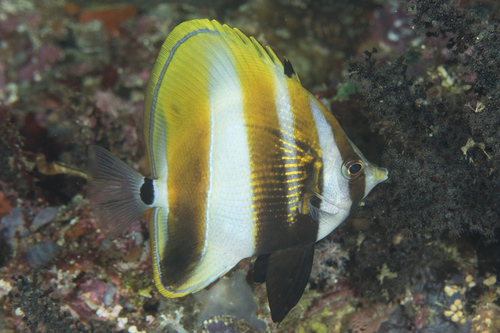
About Chelmonops curiosus Kuiter, 1986
Body Shape
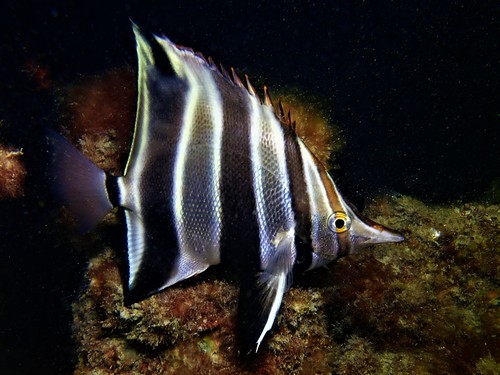
Chelmonops curiosus has a very deep, strongly compressed body that is more than half its standard length. It has a small head, a long tapered snout, and a tiny mouth at the tip of the snout.
Dorsal Fin Structure
It has a single elongated dorsal fin, where the separation between the spiny portion and the soft-rayed portion is barely visible. The first dorsal spine is very small, and spines grow progressively longer toward the posterior of the fin. In juveniles, the soft section of the dorsal fin is rounded, while in adults it is pointed and takes on a triangular profile when raised.
Other Fin Structure
The anal fin is smaller than the dorsal fin, and the caudal fin is truncate.
Body Coloration
The base body color of this fish is steel grey, with variable amounts of black shading that differs between individuals. It has 4 vertical black bars with silver edges, and these bars grow wider toward the tail. The pelvic fins are black.
Juvenile Markings
Juveniles have an ocellus on the soft part of the dorsal fin that fades as the fish matures.
Fin Ray Counts
The spiny portion of the dorsal fin holds 11 spines, and the soft portion has 25 to 27 soft rays. The anal fin has 3 spines and 19 to 20 soft rays.
Maximum Size
This species reaches a maximum total length of 26 centimetres (10 in).
Distribution Range
Chelmonops curiosus is endemic to Australian seas. It occurs along Australia's south coast from Victor Harbor, South Australia, and along the western coast as far north as Shark Bay, Western Australia.
Habitat Preferences
This species lives on coastal rocky reefs, and appears to prefer vertical rock faces, often in turbid water. It will also use man-made structures such as pylons and jetties.
Juvenile Habitat
Juveniles are often found swimming among seaweed beds.
Adult Social Behavior
Adults are typically seen in pairs.
Diet
Chelmonops curiosus is omnivorous, and its diet is made up of small worms, crustaceans, and algae.
Breeding and Territoriality
It breeds in pairs, and appears to be territorial, with each pair defending its own territory.