About Chaetodon adiergastos Seale, 1910
Taxonomic Naming
Chaetodon adiergastos, formally described by Alvin Seale in 1910, is a species of marine ray-finned butterflyfish in the family Chaetodontidae. It has several common names: Philippine butterflyfish, Threadfin butterflyfish, Bantayan butterflyfish, and panda butterflyfish.
Distribution Range
This species is distributed in the western Pacific, ranging from the Ryukyu Islands and Taiwan south to Java and northwestern Australia.
Maximum Length
It reaches a maximum total length of 20 centimeters, which is nearly 8 inches.
Body Coloration
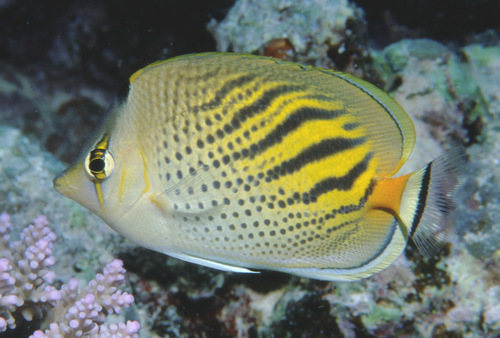
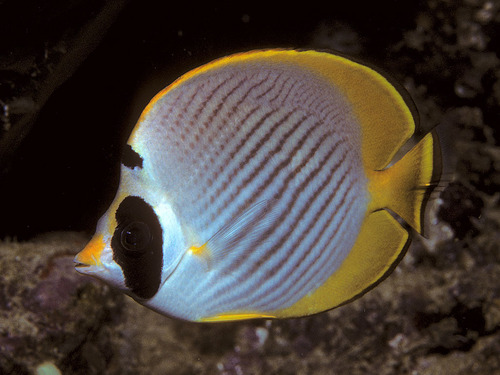
Its body is white, with diagonal brown stripes running along its sides. All of its dorsal, caudal, anal and pelvic fins are yellow.
Facial Markings
It has broad, rounded black bands on the face that cover the eye; these bands are not continuous across the body from one side to the other, and there is a separate black spot centered on the forehead.
Type Locality
The type locality for this species is Bantayan Island, the Philippines.
Subgenus Classification
It is classified in the large subgenus Rabdophorus, which some researchers suggest may deserve recognition as a separate genus.
Species Group Members
Within this subgenus, it belongs to a loose species group that includes Chaetodon flavirostris (black butterflyfish), Chaetodon fasciatus (diagonal butterflyfish), Chaetodon lunula (raccoon butterflyfish), and possibly the unusual Chaetodon collare (red-tailed butterflyfish).
Shared Species Group Traits
While the species in this group vary widely in coloration, all are largish butterflyfish with an oval body outline, and most have a pattern of ascending oblique stripes on their flanks. With the exception of red-tailed butterflyfish, all species in this group have at least a vestigial "raccoon" mask, marked by a white space between the dark crown and dark eye regions.
Habitat and Depth Range
Chaetodon adiergastos inhabits coral reefs at depths between 1 and 30 meters.
Adult Social Behavior
It typically occurs in pairs or groups, most often near soft coral.
Juvenile Habitat and Behavior
Juvenile individuals are solitary, and live on shallow protected reefs or within estuaries.