About Chaetodon plebeius Cuvier, 1831
Coloration
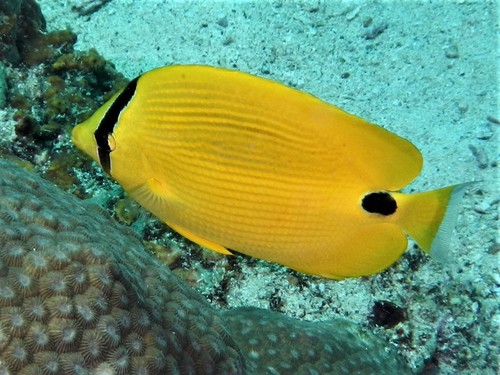
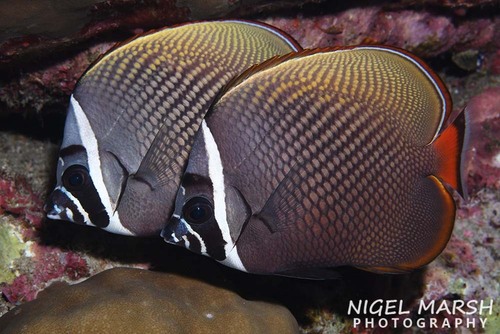
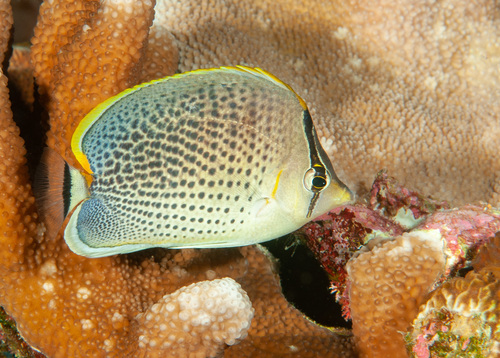
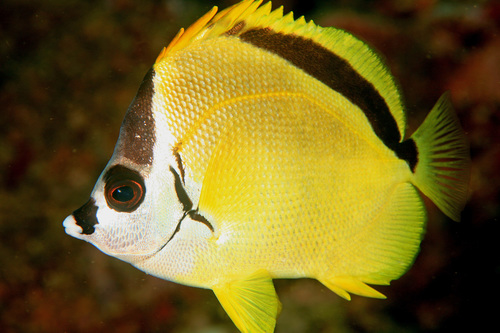
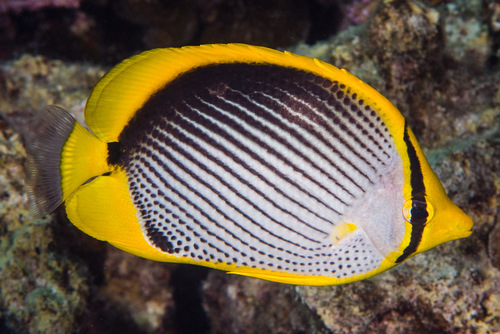
Chaetodon plebeius Cuvier, 1831, commonly called the blueblotch butterflyfish, has a bright yellow body, marked with a large, horizontally elongated blue patch on the flanks above the midline. It has a black spot with bluish white margins on the caudal peduncle, and a vertical black band with bluish white margins that runs through the eye.
Fins and Size
All its dorsal, anal, pelvic and caudal fins are brilliant yellow. Juvenile individuals lack the blue flank patch. The dorsal fin of this species holds 13-15 spines and 16-18 soft rays, while the anal fin has 4-5 spines and 14-16 soft rays. This species reaches a maximum total length of 15 centimetres (5.9 in).
Range
The blueblotch butterflyfish is distributed across the western Pacific Ocean and the eastern Indian Ocean. Its range extends from Vietnam east to Fiji, north to southern Japan, and south to Australia.
Australia and Reefs
It is mostly absent from Indonesia, with the exception of northern Papua. In Australia, it occurs from Rottnest Island in Western Australia north to the Dampier Archipelago, and also from the northern Great Barrier Reef south to Arrawarra Headland near Coffs Harbour in New South Wales. It can also be found on Coral Sea reefs, Elizabeth Reef, Middleton Reef, and Lord Howe Island in the Tasman Sea.
Habitat and Diet
Blueblotch butterflyfish inhabit a variety of coral reef habitats, from shallow lagoons to outer reef slopes, and can be found as solitary individuals or in pairs. Adults are obligate corallivores, feeding primarily on coral polyps from the genus Pocillopora. They have also been recorded feeding on Acropora corals and a small amount of filamentous green algae.
Juveniles and Depth
Juveniles have been observed acting as cleaner fish, removing ectoparasites from other fish species. This species occurs at depths down to 14 metres (46 ft).