About Cercopithecus petaurista (Schreber, 1774)
Tail and Facial Markings
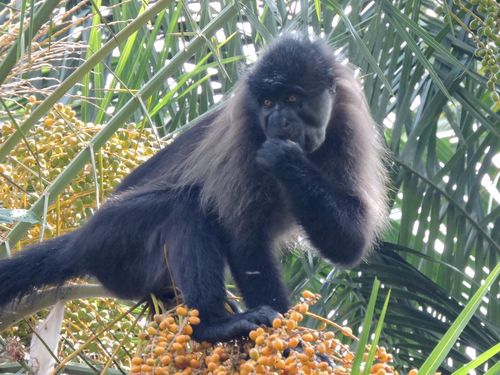
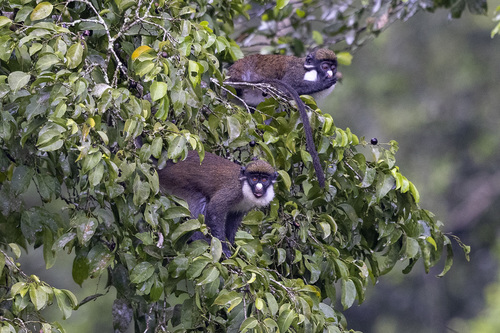
This small arboreal primate species has a long tail. Its face is black with a white spot on the nose, and a white stripe runs from the temple to below the ear.
Dorsal Coloration
The crown, back, outer sides of the limbs, and upper surface of the tail are colored olive-green or khaki; some forms have a reddish tinge on the middle and lower back. Individual hairs, particularly those on the crown, are flecked with black and yellow.
Ventral Coloration
The underparts, inner sides of the limbs, and underside of the tail are white or cream.
Geographic Range
This species occurs in West Africa. Its range covers Guinea-Bissau, Guinea, Sierra Leone, Liberia, Ivory Coast, Ghana, Togo, and it has also been recorded in southeastern Senegal.
Habitat Adaptability
It is adaptable, and can live in a wide variety of habitats including primary and secondary forest, gallery forest, regenerating felled areas, coastal scrubland, bushy areas within farmland, and cultivated fields.
Activity and Locomotion
This species, the lesser spot-nosed monkey, is diurnal, arboreal, and cryptic. It moves cautiously through the forest, rarely climbing into the high canopy, and mostly occupies understorey layers and lianas.
Social Structure
It forms social groups of around ten individuals, typically made up of one adult male, several adult females, and their young.
Diet and Cheek Pouches
It feeds on leaves, fruit, flowers, and insects, and gathers and stores food in its cheek pouches. When these pouches are full they become prominent, and the white throat looks like a snowball.
Reproduction
Little research has been done on the reproduction of this species. Females give birth to a single young after a gestation period of approximately seven months, and breeding does not appear to be seasonal.