About Cercopithecus mona (Schreber, 1775)
Size and Sexual Dimorphism
Cercopithecus mona, commonly known as the mona monkey, shows sexual dimorphism in body size. Males have a head-and-body length ranging from 410 to 630 mm (16 to 25 in), and their tails measure between 520 and 730 mm (20 to 29 in). Females have a smaller head-and-body length, from 340 to 457 mm (13 to 18 in).
Head and Facial Features
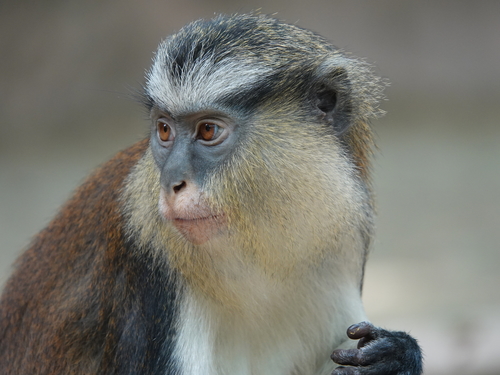
In terms of physical appearance, the mona monkey has a brown crown on its head, a broad whitish brow band, a grey mask of bare skin, and bushy pale fur on the cheeks.
Body and Limb Coloring
The upper body and outer sides of the limbs are deep brown, while the underparts and inner sides of the limbs are creamy-white.
Distinctive Tail Patches
A pair of white hair patches sit on either side of the base of the tail; these patches closely resemble the ischial callosities that baboons and other Old World monkeys have in the same body position.
Native Range
The mona monkey is native to lowland forests in eastern Ghana, Togo, Benin, Nigeria, and western Cameroon.
Introduced Populations
It has also been introduced to Grenada and São Tomé and Príncipe.
Habitat Adaptability
While it is primarily a forest-dwelling species, it can adapt to heavily degraded forest, gallery forest in savannah regions, and mangrove forest in the Niger River delta, and it is generally the most common monkey species found near rivers.
Group Structure
Ecologically, mona monkeys usually live in groups of around twelve individuals led by a single mature male, though larger groups can also form.
Foraging Behavior
Troops move through the forest canopy to forage, feeding mainly on fruit, but also consuming flowers, seeds, insects, and other invertebrates.
Vocalizations
This is a vocal species with a harsh grating call, and mature males give a distinct "ooer" alarm call.
Interspecies Associations
Mona monkeys often associate with other monkey species, including Lowe's mona monkey (Cercopithecus lowei) and the crested mona monkey (Cercopithecus pogonias).