About Cerberus rynchops (Schneider, 1799)
Head and Facial Features
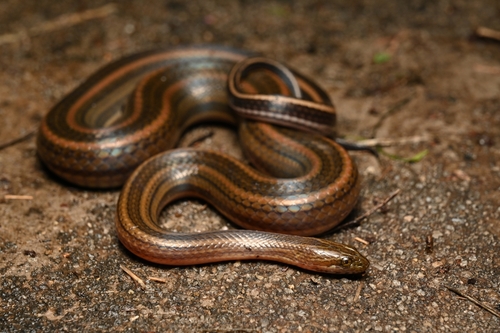
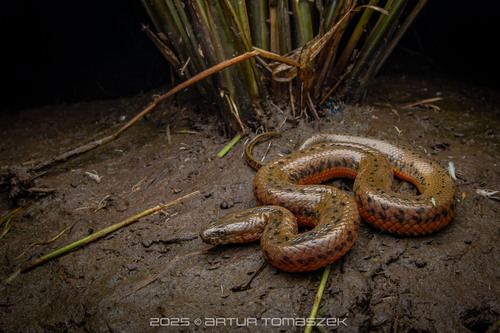
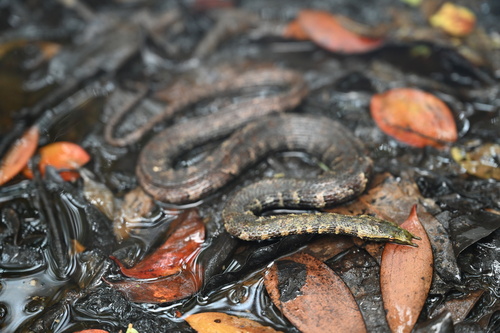
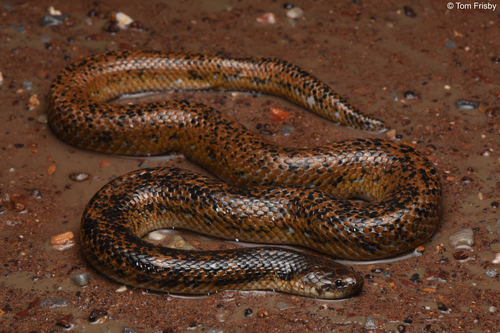
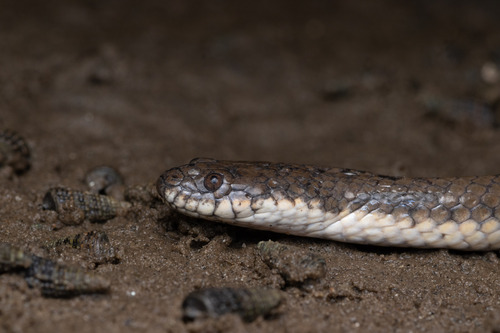
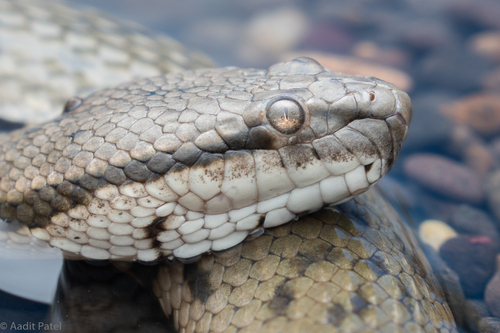
This snake, Cerberus rynchops (Schneider, 1799), has an exposed upper jaw that gives it a dog-like appearance. Its head is long and clearly distinct from the neck. The eyes are small and beady, with rounded pupils.
Coloration
The dorsal surface is dark gray, marked with faint dark blotches and a dark line that runs along the sides of the head, crossing the eyes. The ventral center is cream-colored, with two distinct rows of large, diffuse dark gray spots.
Scale and Scale Count Details
Its scales are distinctly keeled. It has 21–25 midbody scale rows, 132–160 ventrals, and 49–72 subcaudals.
Distribution Range
This is a saltwater-tolerant species found in India (including the Andaman and Nicobar Islands), Bangladesh, Myanmar, Thailand, and northwestern Malaysia. The eastern boundary of its distribution, where it meets Cerberus schneiderii, remains uncertain.
Typical Habitats
It is most commonly found in mangroves, mudflats, streams, ponds, and tidal pools, and has also been recorded on algae patches and even burrowing into mud.
General Behavioral Traits
It is a rear-fanged, mildly venomous, aquatic, and nocturnal snake. It feeds mainly on fish, and is known to eat gobies (including members of Oxudercidae), apogonids, siganids, catfish, mullet, and eels, as well as crustaceans and frogs.
Locomotion Observations
Captive individuals have been observed moving via sidewinding on land. This species was filmed using this sidewinding technique to jump across a Singapore mudflat for the BBC series 'Life in Cold Blood'; before this observation, no snakes were thought to be capable of true jumping.
Additional Physical Adaptations and Reproduction
It has a prehensile tail, which suggests it can climb mangrove trees. It is confirmed to give birth to live young, with litters ranging from 8 to 30 juveniles, which can be born either in water or on land.
Temperament and Hobbyist Popularity
This is a quite docile, mild-tempered, and hardy snake. In recent years it has become a popular animal among snake hobbyists in the Philippines; its popularity is partly due to the bright yellow to orange belly coloring seen mostly in females.
Local Name
In the Philippines, particularly in the Central Visayas area, this snake is commonly known by the local name "tangkig".