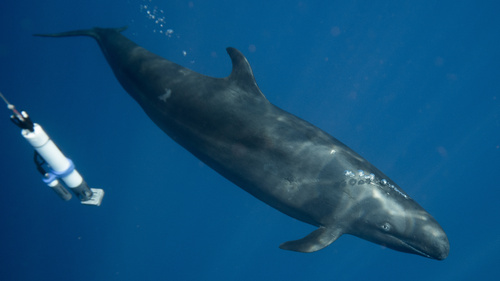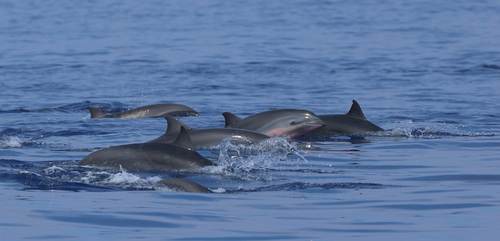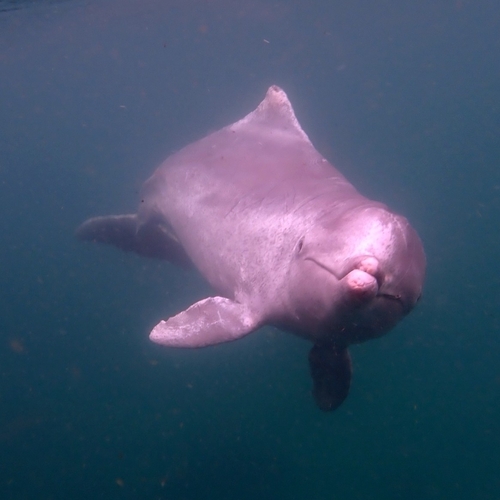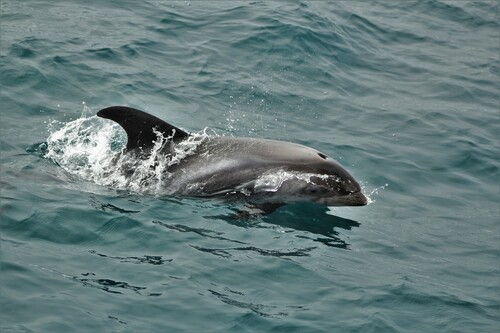
About Cephalorhynchus hectori (P.-J.van Bénéden, 1881)
Taxonomy and General Classification
Hector's dolphin, with the scientific name Cephalorhynchus hectori, is the smallest dolphin species.
Adult Size Range
Mature adults measure 1.2–1.6 m (3 ft 11 in – 5 ft 3 in) in total length and weigh 40–60 kg (88–132 lb).
Sexual Dimorphism
This species is sexually dimorphic, with females about 5–7% longer than males.
Body Morphology
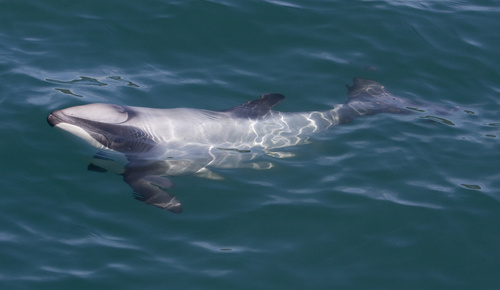
They have stocky bodies, a large fluke relative to their body size, and no noticeable beak.
Distinctive Dorsal Fin
Their most distinctive feature is a rounded dorsal fin with a convex trailing edge and an undercut rear margin.
Population Size Variation
Māui dolphins, a population of this species, tend to be longer than South Island Hector's dolphins.
Adult Coloration
The overall coloration of Hector's dolphins combines grey, white, and black: a black mask surrounds their eyes, and a thin black line runs from the head to the blowhole, while the throat and belly are white and the rest of the body is grey.
Newborn Size
At birth, Hector's dolphin calves are 60–80 cm (24–31 in) long and weigh 8–10 kg (18–22 lb).
Calf Coloration
Their coloration is almost identical to that of adults, though their grey tone is darker.
Fetal Fold Marks
Newborns have distinct fetal fold marks on their flanks that alter the skin color pattern, remaining visible for roughly six months.
Fetal Fold Appearance
These marks are four to six vertical light grey stripes set against darker grey skin.
Depth Range and Proximity to Shore
This species lives in murky coastal waters out to 100 m (330 ft) depth, though almost all sightings occur in waters shallower than 50 m (160 ft), and individuals are most often observed around 1000 m from shore.
Seasonal Movement Patterns
Hector's dolphins make seasonal inshore-offshore movements: they favor shallow coastal waters during spring and summer, and move offshore to deeper waters during autumn and winter, with greater dispersal occurring in winter.
Foraging Site Fidelity
They return to the same locations across consecutive summers, showing high foraging site fidelity.
Drivers of Seasonal Movement
This seasonal movement is thought to be linked to seasonal turbidity patterns and the inshore movement of prey species during spring and summer.
Species Endemism
Hector's dolphins are endemic to coastal regions of New Zealand.
South Island Population Distribution
South Island Hector's dolphins are most abundant in discontinuous high-turbidity regions around the South Island, with the largest populations off the East Coast and West Coast, most notably around Banks Peninsula.
Additional South Island Populations
Smaller, more isolated populations live off the North Coast and South Coast, particularly at Te Waewae Bay, and additional smaller populations are scattered around the South Island including Cook Strait, Kaikōura, the Catlins such as Porpoise Bay and Curio Bay, and Otago coasts including Karitane, Oamaru, Moeraki, Otago Harbour, and Blueskin Bay.
Māui Dolphin Distribution
Māui dolphins are typically found along the west coast of the North Island, between Maunganui Bluff and Whanganui.
2000s South Island Population Estimate
An aerial survey of South Island Hector's dolphin abundance, commissioned by the Ministry for Primary Industries, carried out by the Cawthron Institute, and endorsed by the International Whaling Commission, estimated the total population size at 14,849 dolphins (95% confidence interval = 11,923–18,492).
Earlier South Island Population Estimate
This estimate was almost twice the size of the earlier published estimate of 7,300 dolphins (95% CI 5,303–9,966).
Reason for Estimate Difference
The difference was primarily due to a much larger estimated population along the east coast, which was also found further offshore than previously believed.
2023 Māui Dolphin Population Estimate
The latest population estimate for Māui dolphin, published in 2023, puts the total at just 48 individuals.