About Catalpa speciosa (Warder ex Barney) Warder ex Engelm.
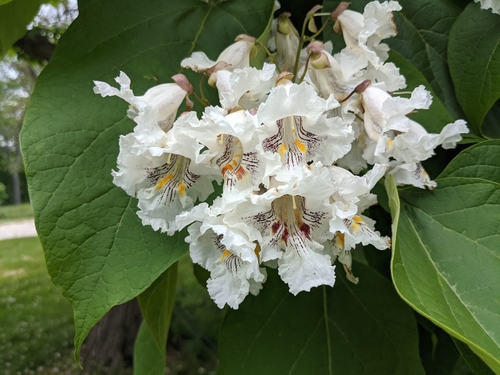
Catalpa speciosa (Warder ex Barney) Warder ex Engelm., commonly called northern catalpa, is a medium-sized deciduous tree. It grows to 15–30 meters (49–98 ft) tall and 12 meters (39 ft) wide, with a trunk that can reach up to 1 meter (3 ft 3 in) in diameter. Its bark is brown to gray and flaky. The large, deciduous leaves are opposite or whorled, heart-shaped, 18–30 cm (7.1–11.8 in) long and 13–21 cm (5.1–8.3 in) broad, pointed at the tip and softly hairy on the underside. The leaves generally do not develop autumn color before falling; they either drop abruptly after the first hard freeze, or turn a faint yellow-brown before falling. Northern catalpa is the last tree to leaf out in spring. Its winter twigs have a distinctive appearance uncommon to most other trees, with sunken leaf scars that resemble suction cups. The whorled arrangement of three scars per node around the twigs is another identifying feature. Its flowers are 3–6 cm (1.2–2.4 in) across, trumpet-shaped, white with yellow stripes and purple spots on the inside, and grow in panicles that hold 10 to 30 flowers. The fruit is a long, thin legume-like capsule, 20–40 cm (7.9–15.7 in) long and 10–12 mm (0.39–0.47 in) in diameter. It turns brown in autumn, often stays attached to the tree through winter, and can be mistaken for brown icicles. The pod holds numerous flat, light brown seeds that each have two papery wings. Northern catalpa is closely related to southern catalpa, and can be told apart by its flowering panicles, which bear fewer larger flowers, and its slightly broader seed pods. It has been recorded in Taiwan, the United States, and the following regions of Chinese Mainland: Guangdong, Shanxi, Henan, Hebei, Zhejiang, Yunnan, Guangxi, Shandong, Jiangsu, Xinjiang, Fujian, Shaanxi, and other areas, and it has been artificially introduced and cultivated. Originally, Catalpa speciosa was thought to be native only to a small area of the midwestern United States near the confluence of the Mississippi and Ohio Rivers. However, in 1976, investigation of an archaeological site on an island in the Ohio River within West Virginia showed Catalpa speciosa was present on the island between 1500 and 1700 CE. This suggests that Catalpa speciosa may have undergone a range decline before European settlement. Today, its range has expanded widely east of the Rocky Mountains beyond its restricted pre-settlement location, which further obscures its true native range. Catalpa speciosa is widely planted as an ornamental tree. It is adapted to moist, high pH soil and full sun, but is able to grow almost anywhere in North America. In the United Kingdom, it has received the Royal Horticultural Society's Award of Garden Merit, confirmed in 2017. Its wood is soft like white pine and lightweight, weighing only 26 pounds per cubic foot when dry. It also resists rot easily; in earlier years, it was used for fence posts, and used less successfully for railroad ties. More modern uses that highlight the wood's attractive grain include furniture, interior trim and cabinetry. Catalpa has one of the lowest shrinkage and expansion rates of any United States hardwood. Only northern white cedar and redwood have lower shrinkage and expansion rates, and by only a small difference. The wood's unique properties make it excellent for carving and boatbuilding. It is often considered a weed tree, and its wood is under-appreciated and underused. The tree's tendency to grow crooked does not improve its reputation as a source of usable lumber. Northern catalpa has been extensively cultivated in Ohio for over 200 years, and is now naturalized in both urban and rural areas. Farmers introduced the fast-growing northern catalpa to Ohio to produce large amounts of timber for fence posts. Three drawbacks exist for its use as a shade or ornamental tree in urban areas. Northern catalpa drops fragments of its long fruits and fringed seeds from winter through spring, creating a need for cleanup. Additionally, it often grows far too large for the space allocated to it in the landscape, crowding out other desirable plants or casting too much shade over them. Finally, its brittle wood, combined with the tree's height, means branches sometimes suffer damage from wind or ice. Fishing enthusiasts often seek out the tree not for the tree itself, but for a common parasite that is used as bait. The catalpa moth caterpillar, Ceratomia catalpae, is widely considered one of the best live baits, and the tree may be planted solely for this purpose, earning the tree common names including worm tree and bait tree.