About Campsis radicans (L.) Bureau
Common Name and Growth Form
Campsis radicans, commonly known as trumpet vine, is a climbing or trailing vine that can reach lengths of up to 10 metres, or up to 12 metres for its climbing stems. Rigid, woody arching secondary vines up to 2 metres long extend outward from the main stem. This species can form dense groundcover, or grow as an aggressive liana that overgrows other plants and buildings.
Climbing Mechanism
It climbs using aerial rootlets and twining stems. Its bark is tan and shreds easily.
Leaf Structure
Leaves are opposite and odd-pinnately compound, meaning they have an odd number of leaflets with one terminal leaflet. The entire leaf can grow up to 18 centimetres long, holding 7 to 13 leaflets.
Leaflet Size and Color
Each leaflet measures roughly 8 centimetres long and 4 centimetres wide. New leaflets are emerald green, maturing to a shiny dark green. Leaflets are shaped ovate to broadly lanceolate with coarsely serrate edges.
Native Range
Campsis radicans is native to the eastern United States and extreme southern Ontario, Canada.
Naturalized Range
It has become naturalized in parts of the western United States, additional areas of Ontario and southern Quebec, parts of Europe, and scattered locations across Latin America.
Historic Habitat
In pre-Columbian North American landscapes, this species was mostly restricted to swamp bottomlands.
Current Habitat
It has since successfully colonized thickets, fencerows, abandoned farmland, floodplain forests and their edges, and river banks.
Flowering and Hummingbird Interaction
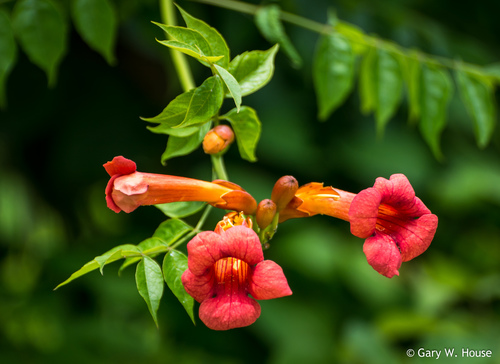
Its flowers bloom for around three months over summer, and are very attractive to hummingbirds including the ruby-throated hummingbird. Many bird species nest in its dense foliage.
Extra-Floral Nectary Feeders
Halictid bees, flies, and ants feed on nectar from the plant's extra-floral nectaries.
Nectar Robbing Behavior
Orchard orioles (Icterus spurius) have been observed engaging in nectar robbing: they puncture and enlarge holes at the base of flowers to access nectar.
Sphinx Moth Nectar Feeding
Certain sphinx moths with elongated proboscises can successfully feed on trumpet vine nectar while hovering in front of flowers.
Seed Pod Development
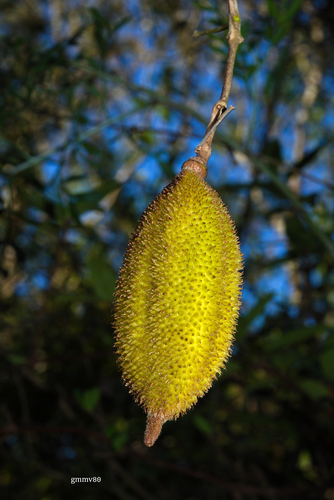
After flowering, the plant produces large seed pods. As pods mature, they dry and split open to release hundreds of thin, brown, paper-like seeds.
Seed Germination
These seeds germinate easily when stratified. Larvae of Clydonopteron sacculana, the trumpet vine moth, feed on the plant's seed pods.
Mammal Foraging and Toxicity
Campsis radicans occasionally serves as a food source for large mammals. This species is slightly toxic if ingested.
Skin Irritation Risk
Contact with its flowers and leaves can cause swelling, skin redness, and contact dermatitis.
Growth Control Methods
It is often considered a weedy species, and its aggressive spread can be controlled by thinning vines during the growing season and cutting them back in winter.
Cultivation Growth Rate
In cultivation, trumpet vine grows very vigorously. In warm weather, it produces aerial rootlets that cling to any available surface, which eventually develop into heavy woody stems several centimeters in diameter.
Cultivation Support and Pruning
It grows well on arbors, fences, telephone poles, and trees, though its vigorous growth can damage these structures over time, so ruthless pruning is recommended.
Invasive Potential Outside Native Range
Outside its native range, this species has the potential to become invasive, even as far north as New England.
Cultivation in Southern Canada
It also grows well across much of southern Canada, but produces fewer flowers when it does not get extended summer heat.
Cultivated Varieties
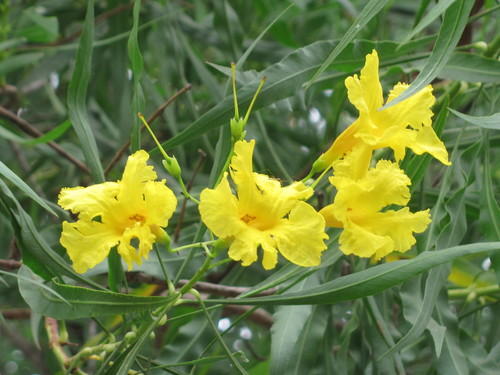
Several cultivated varieties exist: the larger-flowered hybrid 'Mme Galen' was introduced around 1889 by the Tagliabue nurserymen of Lainate near Milan, Italy; the yellow-flowered form Campsis radicans f. flava has earned the Royal Horticultural Society's Award of Garden Merit; and the deeper red cultivar 'Flamenco' is available to gardeners.