About Caranx ignobilis (Forsskål, 1775)
Taxonomic Size Ranking
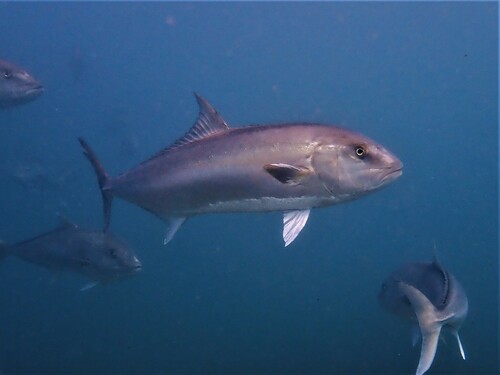
The giant trevally, Caranx ignobilis, is the largest species in the genus Caranx, and the fifth largest species in the family Carangidae, outranked in size only by the yellowtail amberjack, greater amberjack, leerfish, and rainbow runner.
Recorded Size Parameters
This species has a recorded maximum length of 170 cm (67 in) and maximum recorded weight of 80 kg (180 lb); specimens of 50 kg or more are not uncommonly caught by sportfishing.
Historical Hallaniyat Islands Fishery
The Hallaniyat Islands off southern Oman were historically the most productive location for large giant trevally, with 100 lb (45 kg) fish caught almost daily.
Recent Hallaniyat Islands Fishery Status
In recent years, commercial fishing pressure has reduced the local fishery, and large individuals have become much rarer across the islands.
General Body Shape
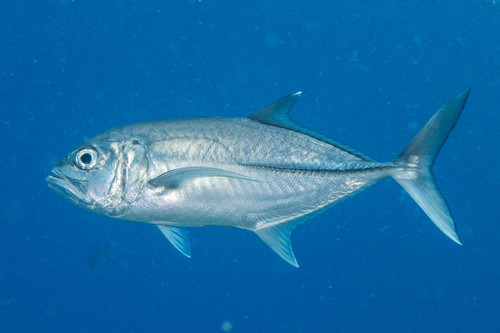
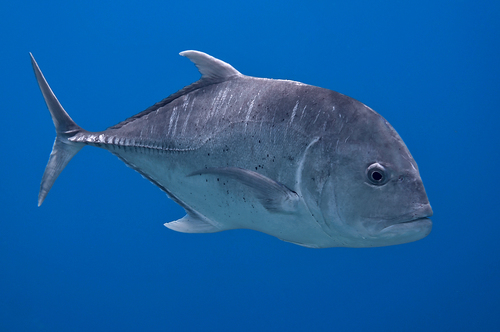
The giant trevally has a body shape similar to many other large jacks and trevallies: it has an ovate, moderately compressed body, with a dorsal profile that is more convex than the ventral profile, particularly toward the head.
Dorsal Fin Structure
Its dorsal fin is split into two separate sections: the first holds eight spines, while the second holds one spine followed by 18 to 21 soft rays.
Anal Fin Structure
The anal fin has two anteriorly detached spines, followed by one spine and 15 to 17 soft rays.
Pelvic Fin Structure
Pelvic fins contain 1 spine and 19 to 21 soft rays.
Caudal and Pectoral Fin Structure
The caudal fin is strongly forked, and the pectoral fins are falcate, longer than the length of the head.
Lateral Line Structure
The lateral line has a prominent, moderately long anterior arch; the curved section intersects the straight section below the lobe of the second dorsal fin.
Lateral Line Scale and Scute Composition
The curved section of the lateral line contains 58 to 64 scales, while the straight section contains zero to four scales and 26 to 38 very strong scutes.
Chest Scaling
The chest is mostly scaleless, with the exception of a small patch of scales located in front of the pelvic fins.
Jaw Dentition
The upper jaw holds a series of strong outer canines with an inner band of smaller teeth, while the lower jaw holds a single row of conical teeth.
Gill Raker and Vertebrae Count
The species has a total of 20 to 24 gill rakers, and 24 vertebrae.
Eye and Jaw Positioning
The eye is covered by a moderately well-developed adipose eyelid, and the back edge of the jaw sits vertically under or just past the back margin of the pupil.
Eye Specialized Cellular Structure
The giant trevally's eye has a horizontal streak with markedly higher densities of ganglion and photoreceptor cells than the rest of the eye.
Eye Adaptation Function
This adaptation is thought to give the fish a panoramic view of its surroundings, removing the need to constantly move the eye, which in turn makes it easier to detect prey or predators in that field of view.
Coloration of Individuals Under 50 cm
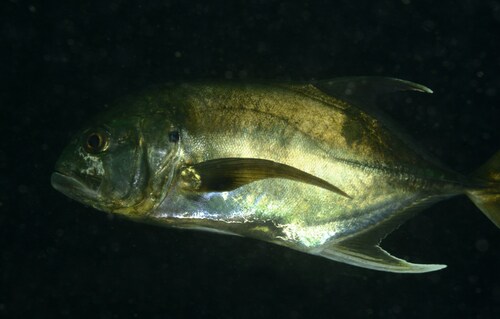
Giant trevally smaller than 50 cm are silvery-grey, with slightly darker heads and upper bodies in both sexes.
Sexual Dimorphism in Coloration for Individuals Over 50 cm
Individuals over 50 cm show sexual dimorphism in coloration: males have dusky to jet-black bodies, while females are much lighter silvery-grey.
Dorsal Body Markings
Individuals with darker dorsal coloration often have prominent silvery striations and markings on their upper bodies, particularly their backs.
Body Dot Patterns
Small black dots a few millimeters in diameter may also be scattered across the body, and coverage of these dots varies from widespread to completely absent.
General Fin Coloration
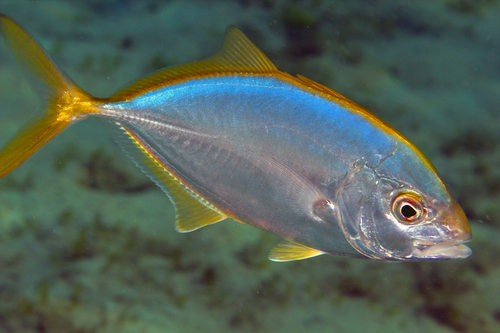
All fins are generally light grey to black, though fish caught from turbid waters often have yellowish fins, with the anal fin showing the brightest yellow tint.
Fin Edge Coloration
The leading edges and tips of the anal and dorsal fins are generally lighter in color than the main body of the fins.
Operculum Markings
There is no black spot on the operculum.
Post-Mortem Coloration Features
Faint broad cross-bands on the fish's sides are occasionally visible after death.
Cannibalism Observation
Giant trevally have been observed preying on and eating dead conspecifics.
Overall Distribution Range
Giant trevally are widely distributed across tropical and subtropical waters of the Bay of Bengal, Indian Ocean, and Pacific Ocean, ranging along the coasts of three continents and hundreds of smaller islands and archipelagos.
Indian Ocean Western Range
In the Indian Ocean, the species' westernmost range is the coast of continental Africa, where it occurs from the southern tip of South Africa north along the east African coastline to the Red Sea and Persian Gulf.
Indian Ocean Eastern Coastal Range
Its range extends east along the Asian coastline, including Pakistan, India, Southeast Asia, the Indonesian Archipelago, and northern Australia.
Australian West Coast Southern Range Limit
The southernmost record of giant trevally on Australia's west coast is from Rottnest Island, located just offshore from Perth.
Indian Ocean Island Records
Throughout the rest of the Indian Ocean, the species has been recorded from hundreds of small island groups, including the Maldives, Seychelles, Madagascar, and the Cocos (Keeling) Islands.
Central Indo-Pacific Distribution
The giant trevally is abundant in the central Indo-Pacific region, found across all archipelagos and offshore islands including Indonesia, the Philippines, Fiji, and the Solomon Islands.
Continental Asian Coastal Range
Along continental Asia, the species has been recorded from Malaysia to Vietnam, but not from mainland China.
Northern Offshore Pacific Range
Despite this, its offshore range extends north to Hong Kong, Taiwan, and southern Japan.
Southern Pacific Range Limit
In the south, the species reaches as far south as New South Wales in Australia, and even to the northern tip of New Zealand in the southern Pacific.
Eastern Pacific Range Limits
Its distribution continues across the western Pacific, including Tonga, Western Samoa, and Polynesia, with its easternmost known limits at the Pitcairn and Hawaiian Islands.
Eastern Tropical Pacific Occurrences
Two individuals were documented in the eastern tropical Pacific in the 2010s: one captured off Panama and another sighted at the Galápagos, but it remains unknown whether the species will become established in this region.
Salinity Tolerance and Habitat Range
Giant trevally inhabit a very wide range of inshore and offshore marine environments, and are known to tolerate the low salinity waters of estuaries and rivers.
Water Column Position
They are semipelagic fish that spend time throughout the water column, but are mostly demersal.
Shallow Coastal Habitats
The species is most common in shallow coastal waters across multiple environments, including coral and rocky reefs and shorefaces, lagoons, embayments, tidal flats, and channels.
Reef Movement Patterns
They commonly move between reef patches, often traveling across large areas of deeper sand and mud bottoms between reefs.
Deep Habitat Preferences of Older Individuals
Older individuals tend to move to deeper seaward reefs, bomboras, and drop-offs away from the protection of fringing reefs, often to depths greater than 80 m.
Shallow Water Visits by Large Individuals
Large individuals, however, often return to these shallower waters to patrol their ranges, typically to hunt or reproduce.
Hawaiian Inshore Habitat Dominance
In Hawaii, juvenile to subadult giant trevally are the most common large carangid in protected inshore waters, while all other large carangid species appear to prefer outer, less protected reefs.
Artificial Reef Association
Giant trevally are also easily attracted to artificial reefs, and studies have found them to be one of the predominant species around these structures in Taiwan.
Estuarine and Freshwater Inhabitation Regions
Juvenile to subadult giant trevally are known to enter and inhabit estuaries, the upper reaches of rivers, and coastal lakes in several locations, including South Africa, the Solomon Islands, the Philippines, India, Taiwan, Thailand, northern Australia, and Hawaii.
Estuary Abundance Variation
In some of these locations, such as Australia, it is a common and relatively abundant estuary inhabitant, while in others, including South Africa and Hawaii, it is much rarer in estuaries.
Salinity Tolerance Range
The species has a wide salinity tolerance: juvenile and subadult fish in South African estuaries have been recorded in salinities from 0.5 to 38 parts per thousand (ppt), and other studies have recorded tolerance of levels less than 1 ppt.
Estuary Water Clarity Preferences
In estuaries, giant trevally can be found in both highly turbid, dirty water and clear, high-visibility water, but in most cases the species prefers turbid waters.
Juvenile Turbid Habitat Selection
Younger fish actively seek out these turbid waters, and when no estuaries are available, they live in the turbid inshore waters of bays and beaches.
Ontogenetic Habitat Shifts
These young fish eventually move to inshore reefs as they mature, before moving again to deeper outer reefs.
Taal Lake Freshwater Population
In the Philippines, a population of giant trevally, locally called maliputo to distinguish them from the marine form named talakitok, inhabit the landlocked fresh waters of the formerly saltwater Taal Lake, where they were once common.
Cultural Depiction of Taal Lake Population
Along with Taal Volcano and Taal Lake, the maliputo is featured prominently on the reverse of the newly redesigned Philippine 50 peso bill.
Adult Social Behavior
Once giant trevally reach sexual maturity, they are solitary, only gathering in schools for reproduction, and more rarely for feeding.
Juvenile and Subadult Social Behavior
Juveniles and subadults commonly school in both marine and estuarine environments.
Mixed Species Schooling Behavior
Observations from South African estuaries show schools of smaller juveniles tend not to mix with schools of other species, but larger subadults will form mixed-species schools with brassy trevally.
Movement Research Purpose
Research has examined the movements of larger giant trevally around their habitats, as well as movement between habitats as the species grows, to understand how marine reserves impact the species.
Adult Home Range Size
Adult giant trevally range back and forth up to 9 km within their home range, and there is evidence of diel and seasonal shifts in habitat use.
Hawaiian Atoll Movement Patterns
In the Hawaiian Islands, giant trevally do not normally move between atolls, but have specific core areas where they spend most of their time.
Diel Habitat Shifts
Within these core areas, habitat shifts across different times of day have been recorded: the fish are most active at dawn and dusk, and usually shift location near sunrise or sunset.
Spawning Migrations
Large seasonal migrations also occur to gather for spawning, and this behavior is also known from the Solomon Islands.
Atoll-Wide Movement Range
Despite not moving between atolls, they do make periodic atoll-wide trips of up to 29 km.
Juvenile Dispersal Range
Long-term studies show juveniles can move up to 70 km away from their protected habitats to outer reefs and atolls.
Ecological Predator Role
Giant trevally are one of the most important apex predators in their habitats, both as adults on reefs and as juveniles in estuaries.
Northwestern Hawaiian Islands Apex Predator Biomass
Observations in the relatively undisturbed waters of the northwestern Hawaiian Islands showed the giant trevally is ecologically very important, making up 71% of apex predator biomass and acting as the dominant apex predator.
Fished Hawaiian Waters Apex Predator Biomass
This proportion is considerably lower in heavily fished Hawaiian waters.
Juvenile Predation Risk
Small giant trevally are prey for sharks.
Adult Aggression Toward Sharks
Conversely, adult giant trevally, either alone or in pairs, have been recorded attacking sharks such as the blacktip reef shark by repeatedly ramming them with their heads.
Shark Attack Outcome
The shark, sometimes even larger than the trevally, may die from the attack.
Shark Attack Behavior Context
The reason for this behavior is unclear, and giant trevally do not attempt to eat the dead shark.
Aggression Toward Humans
Rarely, they have been recorded behaving this way toward humans: a spearfisher in Hawaii broke three ribs when rammed by a giant trevally.
Sharksucker Host Association
Large giant trevally are known to act as hosts for the sharksucker Echeneis naucrates, a fish that normally attaches to the undersides of sharks.