About Atule mate (Cuvier, 1833)
Body Shape
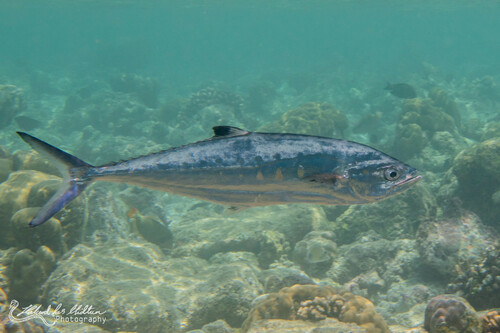
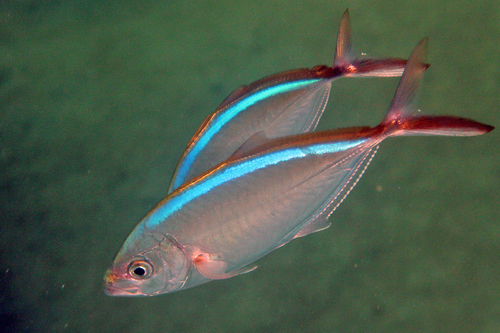
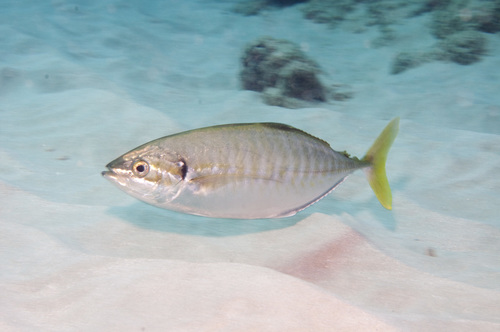
Yellowtail scad (Atule mate) has a moderately compressed, oval-shaped body profile similar to other scads from the Decapterus and Trachurus genera. Both its dorsal and ventral body profiles are nearly evenly convex, and these two lines intersect at the fish's pointed snout.
Dorsal Fin Structure
It has two separate dorsal fins: the first holds eight moderately high spines, while the second has a single spine followed by 22 to 25 soft rays.
Anal Fin Structure
Its anal fin has two anteriorly detached spines, followed by a single spine attached to 18 to 21 soft rays. The terminal soft rays of both the anal and dorsal fins are nearly twice as long as the penultimate rays.
Distal Fin Features
These longer terminal rays form distinctive finlet-like structures, though they stay connected to the main fin by interradial membranes.
Lateral Line Structure
The lateral line is slightly arched in its anterior section; the intersection of the curved and straight sections occurs below the sixth to eighth dorsal soft ray. The curved section holds 39 to 57 scales, while the straight section has 0 to 10 scales and 36 to 49 scutes.
Adipose Eyelid Feature
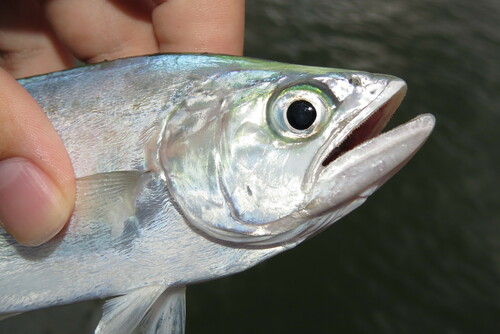
A key distinguishing feature of this species is an adipose eyelid that fully encloses the eye, leaving only a small vertical slit over the pupil. This feature is only visible in individuals longer than 10 cm, as juveniles shorter than this length are still developing the eyelid.
Dentition
Both jaws have a single row of small teeth, though older individuals develop two or three rows of small canine teeth.
Internal Anatomy Counts
The species has a total of 37 to 44 gill rakers and 24 vertebrae.
Species Size
Compared to many other fish in the Carangidae family, the yellowtail scad is a small species. It reaches a recorded maximum length of 30 cm, though individuals are most commonly encountered at around 20 cm.
Body Coloration
The upper body of the yellowtail scad is bright olive green, transitioning to golden green on the ventrum, and becoming silvery white on the underside. Nine to 16 faint grey vertical bars run along the sides of the fish.
Operculum Marking
There is also a black spot slightly smaller than the eye on the upper margin of the operculum and the adjacent shoulder region.
Fin Coloration
The caudal and dorsal fins have a characteristic greenish yellow colour; the pelvic fins are white, and all other fins are hyaline.
Overall Distribution Range
The yellowtail scad is widely distributed across tropical and subtropical regions of the Indo-Pacific.
Indian Ocean Distribution
In the Indian Ocean, it has been recorded as far south as South Africa, and ranges north along the east African coast (including Madagascar) to the Persian Gulf, Red Sea, India, Sri Lanka, and Southeast Asia.
Pacific Ocean Distribution
In the Pacific Ocean, it is most common in Southeast Asia, Indonesia, and the Philippines. It extends south to northern Australia, north to Japan (where only three specimens have ever been recorded), and as far east as Hawaii.
Depth Range
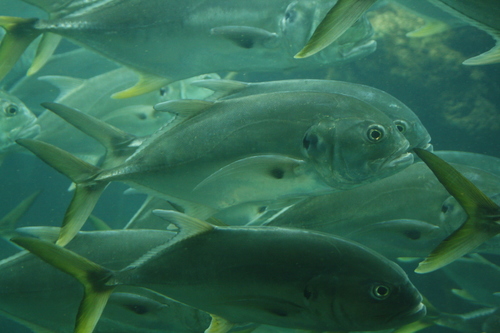
This species is predominantly coastal, and forms schools in inshore waters down to a depth of 80 m.
Adult Habitat
It is often found in large embayments with mangroves, or over coral reefs.
Juvenile Habitat Associations
Like many other carangids, juvenile yellowtail scad gather around floating objects, including jellyfish medusae, and also around manmade structures.
Juvenile Habitat Shift
In Kaneohe Bay, jellyfish medusae disappeared from the bay, which caused the juvenile fish to shift from using natural objects to manmade ones, and this shift has caused concern for future recruitment of the species.