About Carangoides bartholomaei (Cuvier, 1833)
Body Shape
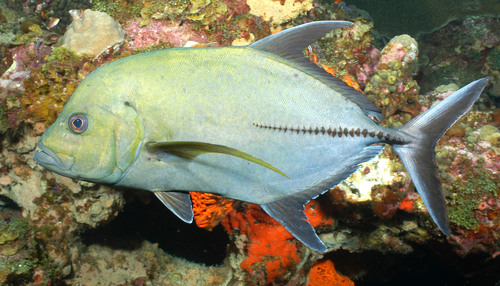
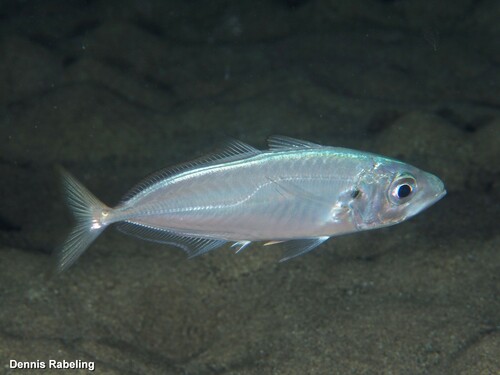
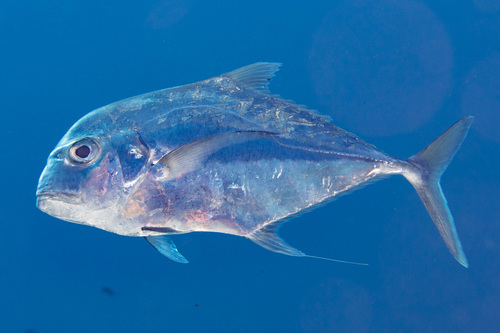
Description: Yellow jack (Carangoides bartholomaei) has the typical body profile of the genus Carangoides: it is moderately deep, compressed, and elongate, with a dorsal profile that is slightly more convex than the ventral profile.
Size and Weight
It is a large fish, reaching a known maximum length of 1 metre (39 in), though individuals are more commonly seen below 45 centimetres (18 in), with a maximum recorded weight of 14 kilograms (31 lb).
Head and Jaw Features
The dorsal profile of the head curves slightly from the snout to the nape, and the eye has a moderately well developed adipose eyelid. A key diagnostic feature is that the upper jaw does not extend to the inner margin of the eye.
Dentition
Both jaws hold narrow bands of villiform teeth, which become wider toward the anterior of the jaw.
Dorsal and Anal Fin Structure
The dorsal fin is split into two parts: the first has seven spines, and the second has one spine followed by 25 to 28 soft rays. The anal fin is similar in structure to the second dorsal fin, with two detached anterior spines, followed by one spine and 21 to 24 soft rays.
Fin Lobe and Pectoral Fin Features
The lobes of the dorsal and anal fins are slightly pronounced, and the pectoral fin is falcate and longer than the head.
Lateral Line Features
The lateral line has a gentle, extended anterior curve, and this curved section is longer than the straight posterior section. The straight section of the lateral line has 22 to 28 scutes.
Body Scales
The rest of the body is covered in smooth cycloid scales, and the chest is completely scaled.
Caudal Peduncle Features
Paired bilateral keels are present on the caudal peduncle.
Vertebrae and Gill Rakers
This species has 24 vertebrae, and a total of 24 to 30 gill rakers.
Body Coloration
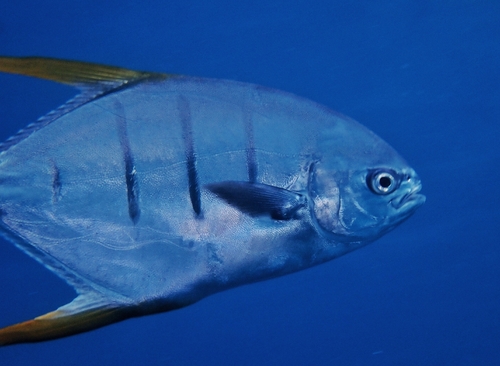
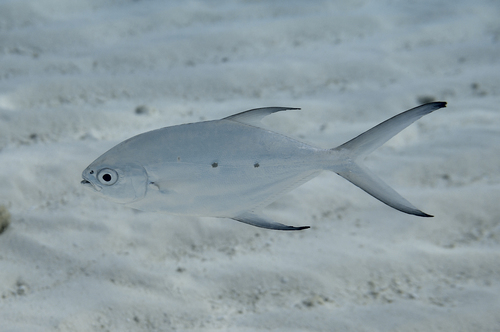
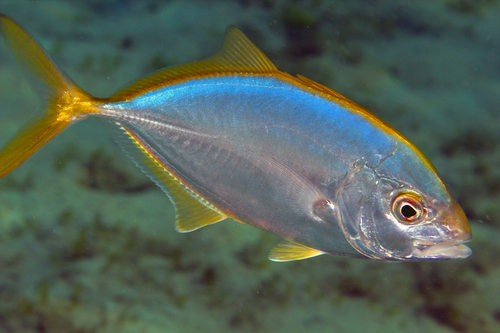
Yellow jack is pale yellow-green-blue on the dorsal side, fading to silver on the underside. Juveniles have about five vertical bands that fade into blotches and disappear entirely as the fish matures.
Fin Coloration
All fins have a hyaline appearance, often with a golden-brown tinge. Older fish are typically more yellow, and large specimens have bright yellow fins.
Western Atlantic Distribution
Distribution and habitat: Yellow jack is found throughout tropical to subtropical regions of the western Atlantic Ocean, ranging along the American coast from Massachusetts to Maceio, Brazil. Its range also covers hundreds of offshore islands in the western Atlantic, including Bermuda, the Bahamas, the West Indies, and the entire Caribbean Sea.
Range Context and Mediterranean Records
Along with the bar jack (Carangoides ruber), it is one of only two Carangoides species native to the Atlantic; all other Carangoides species have Indo-Pacific distributions. It has also been recorded on the Libyan coast of the Mediterranean Sea.
Habitat Preferences
Yellow jack occurs occasionally in inshore coastal waters, but prefers offshore reefs and islands, or open marine waters over the continental shelf. While it is not often found in shallow waters near the American mainland, yellow jack are commonly observed foraging alongside other species in the sandy shallows of many Caribbean islands.