About Picumnus exilis (M.H.K.Lichtenstein, 1823)
Scientific Nomenclature and Size
The golden-spangled piculet, scientifically named Picumnus exilis (M.H.K.Lichtenstein, 1823), measures 9 to 10 cm (3.5 to 3.9 in) in length and weighs 8.5 to 10 g (0.30 to 0.35 oz).
Nominate Male Head Plumage
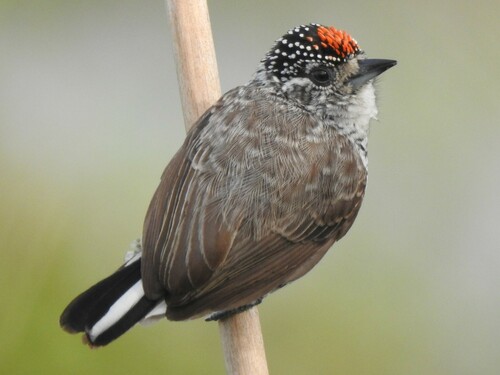
For adult males of the nominate subspecies P. e. exilis, the cap and nape are black, with red spots on the forehead and white spots on the rest of the cap and nape. Their face is yellowish white with dark speckles, has bare grayish skin around the eye, and a pale stripe behind the eye.
Nominate Male Upperbody Plumage
Their upperparts are olive green, with darker feather centers. Their primaries and secondaries are brownish green with yellow-green edges.
Nominate Male Wing Coverts Plumage
Their wing coverts are olive green with narrow white edges and black-edged white tips.
Nominate Male Tail Plumage
The upper side of their tail is dark brown; the innermost pair of tail feathers have mostly white inner webs, and the outer three pairs have a large white patch near the tip.
Nominate Male Underparts Plumage
Their chin, throat, and underparts are pale yellowish with blackish bars, which become more spot-like on the belly.
Nominate Male Soft Parts
The maxilla of the beak is black, and the mandible is black with a silvery base; the legs are grayish, sometimes with a green or blue tinge.
Adult Female Plumage
Adult females are identical to males except that their entire crown has white spots.
Juvenile Plumage
Juveniles are similar to adults but are duller overall, have an olive crown with pale streaking, and more diffuse bars on the underparts.
P. e. undulatus Subspecies Traits
Among the recognized subspecies, P. e. undulatus has a more olive upperparts color than the nominate, with large black feather centers, and the tips of its wing coverts are less contrasting.
P. e. clarus Subspecies Traits
P. e. clarus is yellower on the upperparts than undulatus and has narrower dark bars on the underparts.
P. e. buffonii Subspecies Traits
P. e. buffonii has distinctive black-bordered white spots on the tips of its wing coverts.
P. e. alegriae Subspecies Traits
P. e. alegriae is generally duller than the nominate, more olive on the upperparts, and whiter on the underparts.
P. e. pernambucensis Subspecies Traits
P. e. pernambucensis has more olive upperparts than the nominate and more even bars on the underparts.
Subspecies Distribution
Each subspecies of the golden-spangled piculet has a distinct distribution: P. e. clarus is found in east-central Venezuela; P. e. undulatus ranges from eastern Colombia through southeastern Venezuela into western Guyana and the state of Roraima in northern Brazil; P. e. buffonii occurs north of the Amazon River, from eastern Guyana through Suriname and French Guiana to Amapá in northeastern Brazil; P. e. pernambucensis is found in the states of Pernambuco and Alagoas in northeastern Brazil; P. e. alegriae occurs in northeastern Brazil south of the Amazon, from northeastern Pará to northwestern Maranhão; P. e. exilis, the nominate subspecies, is found in east central Brazil from Bahia south to Espírito Santo.
Habitat Types
The golden-spangled piculet lives in a variety of wooded landscapes, including rainforest, cloud forest, and secondary forest. It also occurs in stands of bamboo, mangroves, open woodland, and along savanna edges.
Elevation Range
Its elevation range extends from sea level to about 1,900 m (6,200 ft) in the tepui region where Venezuela, Guyana, and Brazil meet.