About Caluromys lanatus (Olfers, 1818)
Coat Coloration
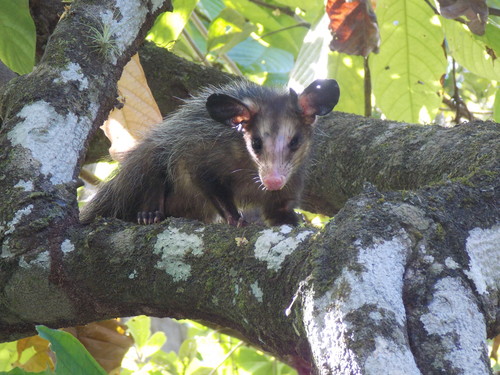
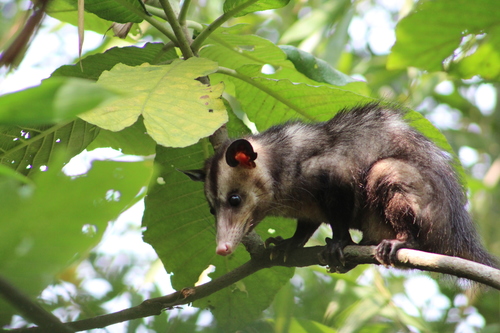
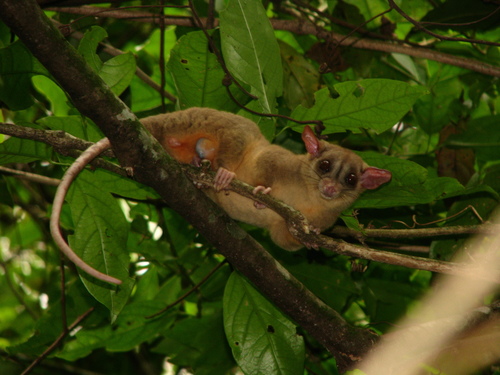
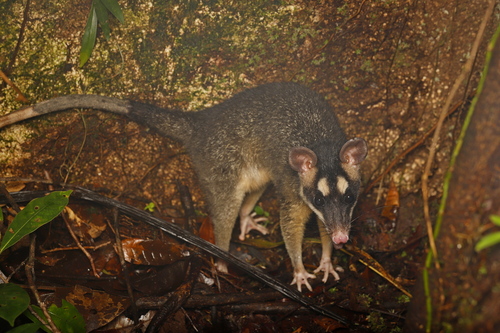
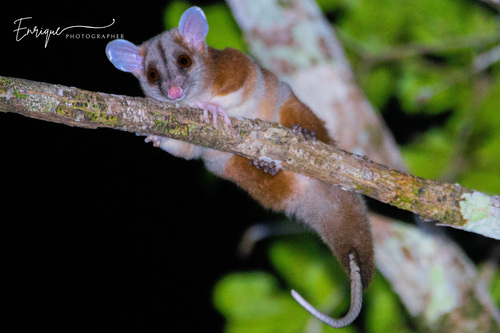
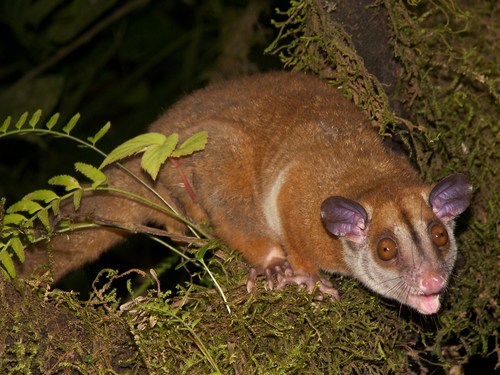
The brown-eared woolly opossum, Caluromys lanatus, has a brown to reddish brown coat and similarly colored limbs, with a yellow to orange underbelly.
Ear Characteristics
Its ears are hairless, brown, and have a faint pink tint.
Tail Fur Distribution
Its tail is furred along up to half its length on the dorsal (back) side, and up to 20% of its length at the base; fur becomes less bushy toward the tip, leaving the final 30% of the tail length bare.
Naked Tail Appearance
This naked tail section is typically white with a yellowish tinge and spotted with brown.
Coat Variation
The coat may have a gray tinge, and develops an orange shade on the shoulders, limbs, and crown; young individuals are typically grayer overall.
Fur Texture
The fur is fairly long, soft, and thick.
Facial Markings
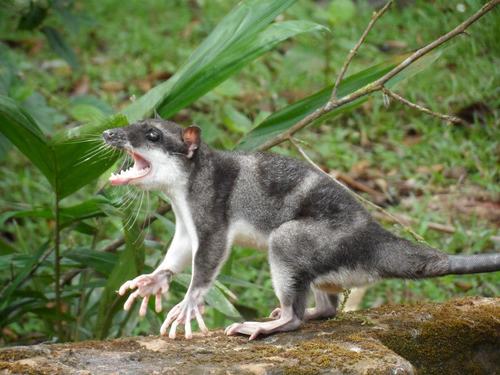
The species has a grayish white face with faint orange rings surrounding the eyes, and a dark stripe that runs up the nose, between the eyes, and extends to the back of the ears.
Subspecies Color Differences
Subspecies vary in coloration: C. l. circur is mostly grayish brown, while C. l. lanatus is pale brown and lacks spots on the tail.
Body and Tail Length
Head-and-body length ranges from 20 to 32 centimetres (7.9 to 12.6 in), and tail length ranges from 33 to 45 centimetres (13 to 18 in).
Weight
Individuals weigh 31 to 52 grams (1.1 to 1.8 oz).
Hindfoot and Ear Length
Hindfeet measure 3 to 5 centimetres (1.2 to 2.0 in), and ears measure 3 to 4 centimetres (1.2 to 1.6 in).
Dental Formula
Its dental formula is 5.1.3.4 / 4.1.3.4, which is typical of didelphids.
Distinction from Bare-tailed Woolly Opossum
The brown-eared woolly opossum differs from the bare-tailed woolly opossum by having a bushier tail (the bare-tailed woolly opossum’s tail becomes bare abruptly after the first third of its length) and a pouch that opens toward the front rather than along the midline.
Distinction from Derby's Woolly Opossum
It differs from Derby's woolly opossum by having brown rather than white limbs, and no gray fur between the shoulders.
Braincase Characteristics
Compared to other opossums, it has a comparatively large braincase.
Habitat Types
This species inhabits humid tropical forests including primary, secondary, and gallery forests, as well as plantations, mangrove forests, xerophytic forests, and the more densely wooded areas of the cerrado and pantanal.
Elevation Range
It most commonly occurs up to 500 metres (1,600 ft) above sea level, though individuals have been recorded as high as 2,600 metres (8,500 ft).
Geographic Range
Its range lies east of the Andes, extending from Bolivia, central Colombia, eastern Ecuador, Peru, and western and southern Venezuela to northeastern Argentina, western, central, and southern Brazil, and eastern and southern Paraguay.
Conservation Status
The IUCN currently lists this opossum as least concern due to its wide distribution and presumed large population, though it is threatened by deforestation in some parts of its range.
Activity and Social Behavior
The brown-eared woolly opossum is nocturnal (active mainly at night) and generally solitary, though individuals have been observed foraging in pairs.
Diet Composition
It is omnivorous, feeding on fruits from plants such as Cecropia, Piper, and Solanaceae species, as well as nectar, small invertebrates, and small vertebrates.
Digestive Adaptation
One study classifies it as a typical frugivore with a well-developed cecum.
Pollination Role
When feeding on nectar, it likely contributes to pollinating flowers of Pseudobombax tomentosum and Quararibea cordata.
Vocalization
It is generally silent.
Female Reproductive Traits
Females have an estrus cycle 27 to 29 days long, and develop a pouch before carrying young.
Litter Size
Litter size ranges from one to four, while the related bare-tailed woolly opossum can have litters of up to seven young.