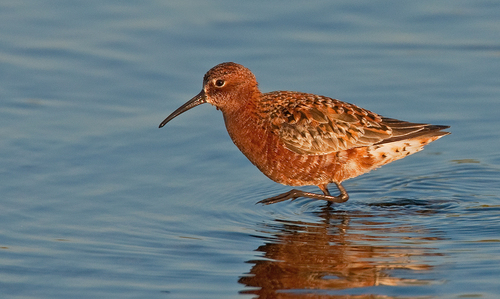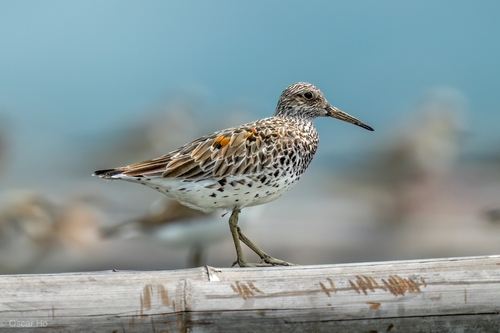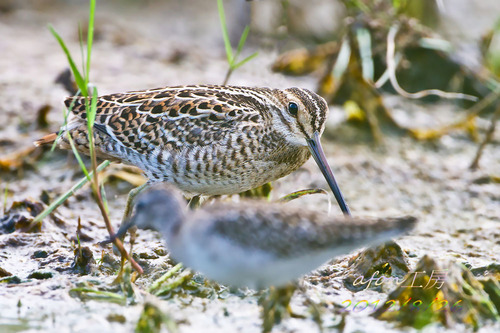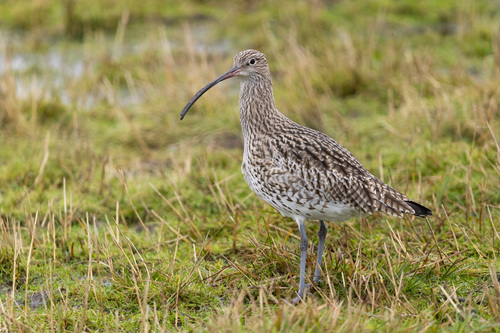
About Calidris maritima (Brünnich, 1764)
Adult Plumage Features
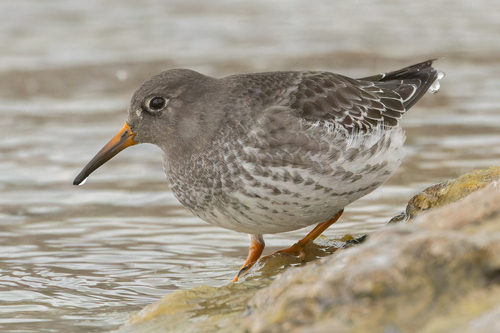
Adults of this species have short yellow legs, and a medium-thin dark bill with a yellow base. Their upper bodies are dark with a faint purplish gloss, while their underparts are mainly white. The breast has grey smudging, and the rump is black.
Adult Size Measurements
Adults measure 20–22 cm (7.9–8.7 in) in total length, 42–46 cm (17–18 in) in wingspan, and weigh 50–105 g (1.8–3.7 oz).
Global Breeding Range
The purple sandpiper's breeding range stretches from the arctic islands of northern Canada, eastward through Greenland, Iceland, Svalbard, and northern Scandinavia, all the way to Western Siberia and the Taymyr Peninsula.
High Arctic Breeding Habitat
In the high Arctic, this sandpiper breeds at low altitude on tundra, sometimes located far from the coastline.
Subarctic Breeding Habitat
In the subarctic regions of Sweden and Norway, it breeds on barren mountain slopes near the edge of permanently frozen ground.
General Migration Patterns
Birds that breed at high latitudes migrate south to spend the winter on rocky shores on both sides of the North Atlantic. They winter along the North American coast as far south as South Carolina, and along the eastern Atlantic coast as far south as France and northern Iberia.
Specific Breeding Migration Route
Birds that winter in northern Scotland and southwest Ireland migrate to Canada's Baffin Island and Devon Island to breed.
UK Winter Population
In Britain, purple sandpipers occur in good numbers during winter, mainly along the east and south coasts, where they prefer rocky shorelines next to the sea.
UK Breeding Population
It is a much rarer breeding bird here, found only in a localised area of the Cairngorms National Park, where 1–3 pairs have bred since 1978. Records of breeding by this species in the UK are monitored and archived by the Rare Breeding Birds Panel.
Migrant Timing and Range
Purple sandpipers are late migrants, moving to rocky, ice-free Atlantic coasts for winter. Most do not travel any further south than North Carolina and northern Portugal.
Species Behaviour
They are fairly gregarious, forming small flocks that often include ruddy turnstones. This species is tame and approachable.