About Purpureicephalus spurius (Kuhl, 1820)
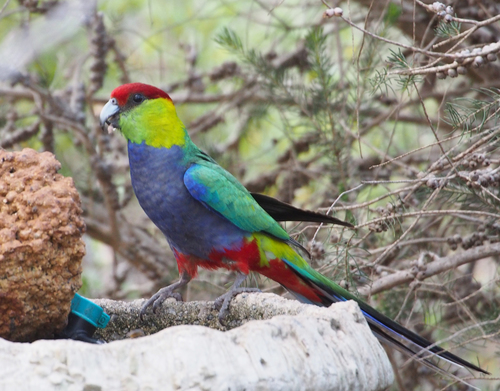
The red-capped parrot (Purpureicephalus spurius) has a long bill and bright, clearly patterned plumage, which has been variously described as magnificent, gaudy, or clownishly coloured. Adults are distinctive, easily recognised medium-sized parrots, measuring 34–38 cm (13.5–15 in) in length with a 42–48 cm (16.5–19 in) wingspan, and weighing 105–125 g (3.7–4.4 oz).
Adult Male Plumage
The adult male has a crimson forehead and crown that extends from the gape or base of the lower mandible through the eye, paired with grey-brown lores. Its hindneck and cheeks are green, and ear coverts are a more yellow-green shade.
Male Plumage Details
In March and April, birds with newly grown plumage may have fine black edging on crown feathers and ear coverts. Feathers of the head, back, and underparts have grey bases that are generally hidden.
Male Upperparts
Upperparts including the wings are dark green, the rump is yellow-green, and the tail is green with a dark blue tip. Underparts are purplish-blue, flanks are green and red, the iris is dark brown, and the eye ring is dark grey.
Male Bill Features
The bill is pale blue-grey with a dark grey tip, and the upper mandible is elongated into a slender hook.
Female Plumage Differences
Female colouring is similar to that of males, though slightly duller; the red plumage is less intense, and red flanks are spotted with some green and yellow. The female's breast is a more greyish violet rather than purple.
Female Wing Markings
A whitish stripe is visible on the underside of the wing when the bird is in flight. Females have white spots on seven or more underwing feathers, though a small number of individuals of both sexes lack spots entirely.
Sexing Subadults
Birds with white spots on fewer than seven underwing feathers can be either female or subadult male. Males have a slightly wider and flatter head (noticeable when comparing individuals directly), as well as longer wings and a longer tail.
Adult Behaviour and Moulting
Adult moulting occurs during Southern Hemisphere summer and autumn. The red-capped parrot has a distinctive upright posture when perching and walking.
Juvenile Initial Plumage
Juveniles have mostly greenish plumage before starting their first moult around August. Their plumage after the first moult closely resembles that of adult birds.
Juvenile Marking Development
Faint adult markings develop starting from a dark green crown with a reddish frontal band, the same grey-violet breast colour seen on adult females, and red underparts mottled with green. The juvenile bill is more orange, but darkens to the adult pale blue-grey colour by two to five months of age.
Juvenile Sexing Traits
Juvenile males have white spots on ten or fewer underwing feathers; juveniles with more than ten spots cannot be sexed. Male subadults often retain residual white spots on their wing feathers.
Vocalisation Types
The species' rapidly repeated contact call has been transcribed as krukk-rak or crrr-uk, while its alarm call is a series of high-pitched loud notes. Males chatter loudly when agitated or marking nest territory, unlike rosellas, which do not chatter while feeding.
Juvenile Calls
Nestlings and fledglings up to two weeks after leaving the nest produce a high-pitched two-syllable food begging call.
Species Distribution Range
The red-capped parrot is found in the Southwest Australia ecoregion, where it inhabits dense to open forest, woodland, and coastal heathland. Its range extends south from the Moore River along the coast to Esperance, with recorded occurrences inland from the southern coast as far as Gingin and Mooliabeenee.
Movement Patterns
Within its range, it is sedentary in higher rainfall areas, and locally nomadic in drier areas. It occurs mostly within 100 km (60 mi) of the coastline, and becomes sparser further inland.
Primary Habitat Association
Its usual habitat is eucalypt forest or woodland, and its distribution is mostly associated with the marri tree (Corymbia calophylla), which provides a constant food source and has expanded its range and population since European settlement. The parrot can also be found in vegetation dominated by other tree species including jarrah (Eucalyptus marginata), tuart (E. gomphocephala), wandoo (E. wandoo), yate (E. cornuta), and peppermint (Agonis flexuosa).
Modified Habitat Use
This seed-eating species is found in farmland, orchards, and suburban areas of Perth. It also occurs around remnant marri stands retained as shade trees on farmland in the western Wheatbelt and Swan Coastal Plain.
Habitat Threats
Land clearing and tree removal can negatively impact this species.
Roosting and Avoided Habitats
Red-capped parrots use large trees for night roosting and resting during midday. They generally avoid blue gum (Eucalyptus globulus) and pine plantations.
Suburban Wetland Occurrence
The species is frequently seen at lake reserves in suburban areas of the Swan Coastal Plain, in sight of waders (Charadriiformes) that live in freshwater to brackish wetlands. It is common at the Forrestdale and Thomsons Lakes Ramsar Site, Bibra Lake, and Benger Swamp wetland, all regions with high avian diversity.
Reserve Occurrences
It also occurs at Dryandra Woodland, a species-rich reserve with jarrah and marri stands over sheoak (Allocasuarina huegeliana) and dryandra (Banksia ser. Dryandra), habitat the parrot favours. It is commonly sighted at Two Peoples Bay Nature Reserve and along roadsides around the Stirling Range and Porongorups.