About Alisterus scapularis (Lichtenstein, 1816)
Adult Body Length
Adults of both sexes of Alisterus scapularis are approximately 43 cm (17 in) long, this measurement includes the species' long, broad tail.
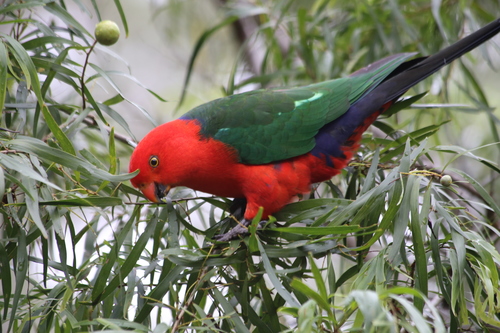
Male Plumage - Head and Torso
The adult male has red coloration on its head, breast, and lower undersides. A blue band runs along the back of its neck, between the red upper region and the green back.
Male Plumage - Wings, Tail and Rump
The male's wings are green, with each wing bearing a pale green shoulder band; its tail is green, and its rump is blue.
Male Facial Features
The male has a reddish-orange upper mandible with a black tip, a black lower mandible with an orange base, and yellow irises.
Female Plumage
Female plumage differs greatly from that of the male: females have a green head and breast, a grey beak, and their pale shoulder band is either small or entirely absent.
Juvenile Appearance
Juveniles of both sexes have brown irises and a yellowish beak, and are otherwise similar in appearance to the female.
Subspecies Count
There are two recognized subspecies.
A. s. minor Characteristics
A. s. minor occurs at the northern limit of the species' range, and resembles the nominate subspecies in appearance, but is smaller, typically around 5 cm (2 in) shorter in total length.
Melanin Deficient Morph
In rare individuals that have areas lacking melanin, their feathers range from orange to yellow. These individuals can look strikingly different from the more common scarlet-and-green variety.
Species Distribution Range
The Australian king parrot, Alisterus scapularis, is distributed from northern and central Queensland to southern Victoria.
Species Social Occurrence
They are frequently observed in small groups alongside various rosella species.
Non-Upland Habitat Occurrences
Outside of their typical eastern upland habitat, they also occur in Canberra during winter, the outer western and northern suburbs of Sydney, and Carnarvon Gorge in central Queensland.