About Burhinus indicus (Salvadori, 1866)
Common Name & Size
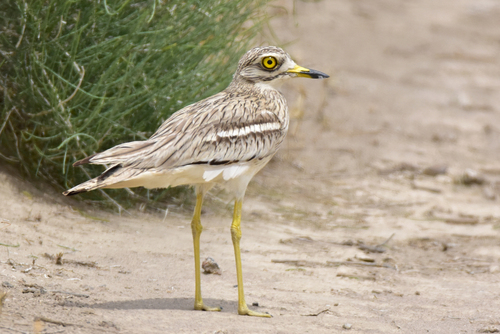
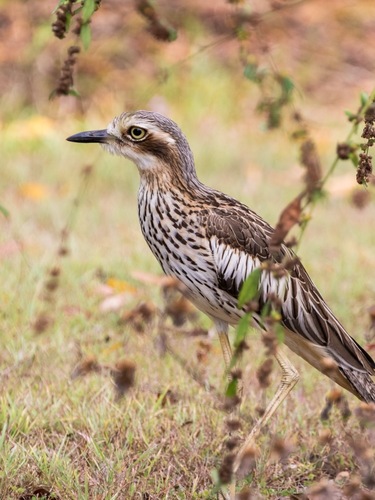
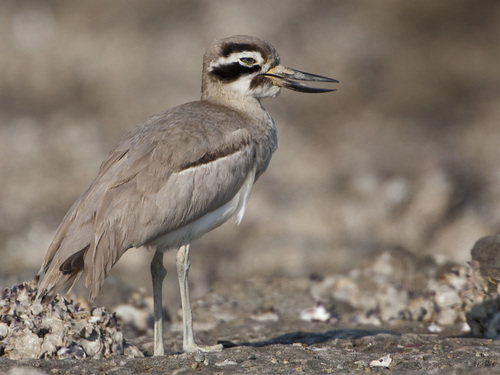
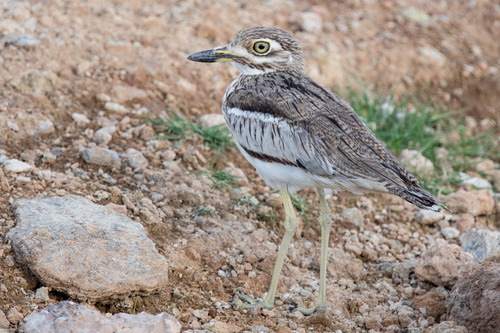
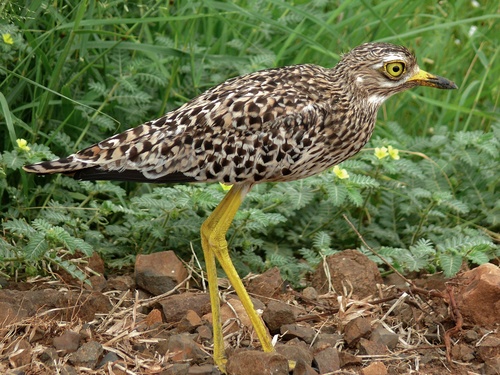
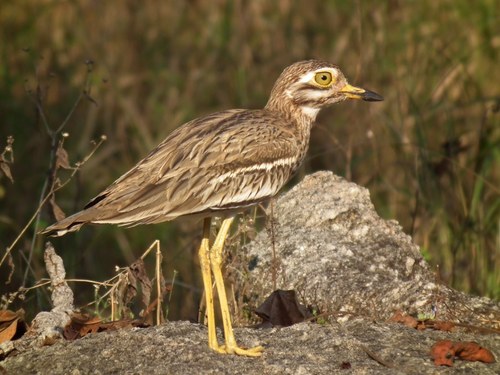
Burhinus indicus (Salvadori, 1866), commonly called the Indian stone curlew, is a stocky, brown ground bird that reaches around 41 centimeters in length. It has a plover-like overall appearance, with dark streaks patterned over a sandy brown base color.
Head Markings
Its large head features a dark stripe that borders a creamy moustachial stripe located below the eye, alongside a narrow creamy supercilium. It has large yellow eyes, stout legs, and thickened knees, which gives the group its common name "thick-knee".
Sexual Dimorphism & Immature Plumage
The sexes are identical in appearance; immature individuals are paler than adults, and have more prominent buff coloring and streaking on their underparts.
Wing Markings
In flight, this species shows two prominent white markings and an additional white patch on its darker primary feathers; when at rest, a broad pale band is visible on the wing.
Activity Pattern
The Indian stone curlew is most active at dawn and dusk, and calls primarily at night.
Vocalization
Its call is a series of sharp whistled notes, typically repeating "pick-pick-pick-pick", which sometimes ends in a pattern of "pick-wick, pick-wick". It occurs in small groups; during the day, it usually stays standing still in shade under bushes.
Habitat
This species is found in dry deciduous forests, thorn forests, scrubby riverbeds, groves, gardens, thin dry deciduous forest, scrub, stony hillsides, and fallow lands.
Distribution
Its confirmed distribution is restricted to Bangladesh, Bhutan, Cambodia, India, Laos, Myanmar, Nepal, Pakistan, Sri Lanka, Thailand, and Viet Nam.
Diet
Its diet is made up primarily of insects, worms, and small reptiles, and it occasionally eats seeds.