About Burhinus grallarius (Latham, 1801)
Taxonomy and Genus Context
Burhinus grallarius is a species in the genus Burhinus, a group of large-eyed, long-legged terrestrial foragers called thick-knees.
Overall Build and Coloration
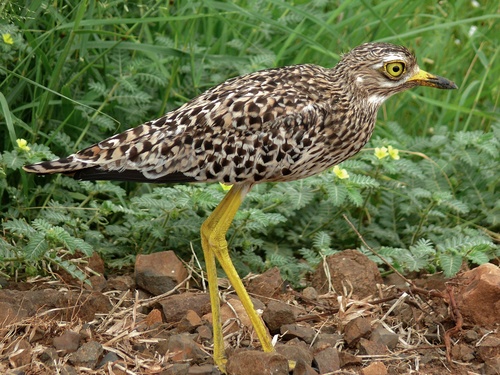
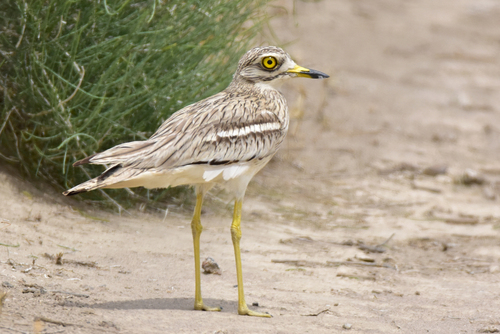
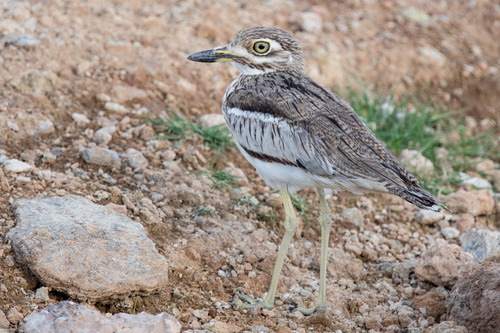
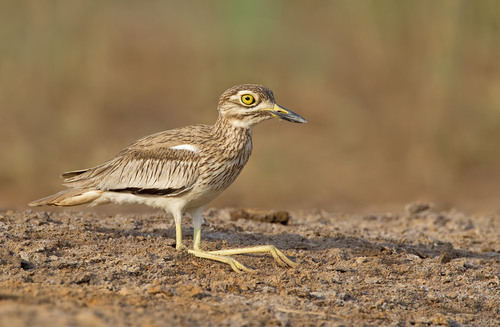
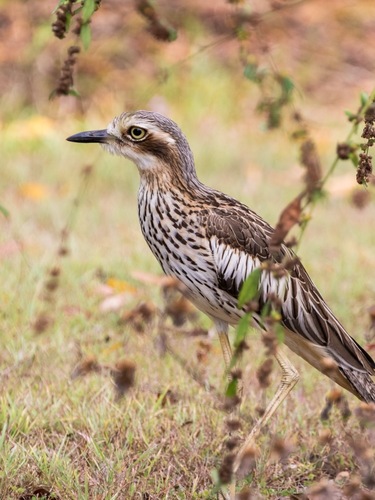
This species has a slender build, with overall grey and brown coloration and distinctive markings. It has prominent dark streaks across the buff and greyish white feathers of its upperparts, and spotted markings on the wings.
Underpart Plumage
The underpart plumage is also heavily streaked with dark brown over white and buff feathers.
Size and Morphometrics
The species has a total length of 550 millimetres, including a bill around 45 millimetres long and a tail 180 millimetres long, and its wingspan approaches 1 metre.
Extended Wing Markings
When the wing is extended, its black flight feathers reveal a light buff patch, and the plumage has a pale area at the shoulder.
Head Markings
The head features a band of dark feathers that runs over the eye and down the neck, with buff coloration on the forehead and brow above the eye.
Facial and Soft Tissue Features
The iris is bright yellow, and the bare skin near the eye is black. Its long legs are olive-green, and the bill is dark-toned.
Sexual and Juvenile Plumage
The sexes have similar appearance; juveniles have paler plumage but are otherwise similar to adults.
Eggshell Coloration
Eggshell color is typically stone grey with brownish blotching, though this varies and often matches the surrounding environment to provide camouflage.
Egg Size Variation
Egg size is also variable, with an average measurement of 53 × 39 mm; variation has been recorded between eggs in nearby nests and even between the two eggs in a single brood.
Similar Sympatric Species
The beach stone-curlew (wee-lo), another species in the same family, can be distinguished by its plumage and larger bill, and is found only on the coast. Confusion with nightjars is possible, but species in the genus Caprimulgus are smaller and fly differently.
General Habitat Preferences
Burhinus grallarius, commonly called the bush stone-curlew, has a broad habitat preference, but is rarely found in rainforest, arid desert, urban areas, or agricultural regions. It occurs in open forest, eucalyptus woodland, rainforest edges, grassy plains, arid scrubland, and along inland watercourses.
Movement Patterns
It is not a migratory species, though local weather conditions may prompt it to move to a different nearby site.
Distribution in Australian Cities
It is common near the northeastern Australian cities of Brisbane, Cairns, and Townsville, but does not occur in urban areas in the southern part of its range.
Australian Range Overview
It is found across most of Australia, except the West Australian coast and Tasmania.
Population Status by Region
It remains abundant in tropical and subtropical northern Australia, but has become very rare in the less fertile south where it was once common.
Historical Population Trend in Southwest Australia
Historical records show the species was common, sometimes abundant, in southwest Australia, but its population declined sharply there during the 20th century.
Primary Extirpation Threat
Its extirpation from this region is largely attributed to the introduction of the red fox Vulpes vulpes. Predation threat from cats is noted to sometimes be absent where foxes have already become established.
Threats from Rabbit Control Efforts
Control efforts targeting the European rabbit, another introduced pest, also threatened this species: bush stone-curlews were killed by water poisoning used for rabbit control and accidentally caught in rabbit traps.
Mainland Range Reduction
The species' original range covered most of the Australian mainland, but has since been reduced by around 90%.
Offshore and New Guinea Distribution
It also occurs on offshore and nearby islands, and a very small breeding population has been recorded at a site in southern New Guinea.
Human-Associated Protection
Bush stone-curlews have sometimes been reported to gain protection from foxes by living near rural properties, where farmers tolerate them and farm dogs deter foxes. Young bush stone-curlews have even become partially domesticated at rural properties.
Agricultural Habitat Benefits
In some cases, agricultural activity has benefited local populations; Frederick Whitlock noted in 1903 that the bush stone-curlew gained access to open water and favored partially cleared forest where patches of shrubland remained.
Agricultural Habitat Harm
However, dramatic population declines in former strongholds that were converted to European-style farming were recorded in the mid-20th century.
Social Structure by Season
Bush stone-curlews are sometimes seen in flocks, but during the breeding season, most local areas only hold a single mated pair.
Nesting Parental Care
Like other ground-nesting birds, females only select a site to lay eggs and do not add any structure or adornment to the nest; both parents care for the nest site.
Incubation Disturbance Response
If disturbed during the first few days of incubation, the brooding parent will quietly leave the site, but it will stay to defend the egg at later stages of development.
Egg Defense Behaviors
The parent will hold a frozen posture and lie over the eggs to hide them. If an intruder finds an egg, the parent may move it a short distance away.