About Buddleja coriacea J.Rémy
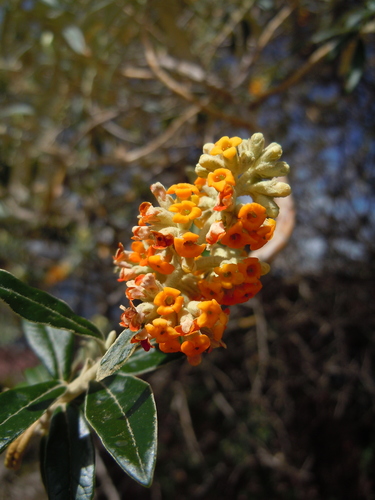
Buddleja coriacea J.Rémy is typically a densely crowned, sprawling trioecious shrub or tree that branches almost at ground level. In the wild, it usually grows to less than 4 m in height, though it can occasionally reach 12 m. Its stems can grow up to 40 cm in diameter, and it has fissured bark. This species is most easily identified by its small, thick, leathery leaves, which measure 1–4 cm long by 0.5–1.5 cm wide, and have 3–4 mm petioles. The upper leaf surfaces are dark green and glabrous, which contrasts sharply with the leaf undersides that are covered in a cinnamon-brown indumentum. Its scented inflorescences are made up of 3–8 pairs of head-like cymes 0.9–1.2 cm in diameter, each holding 8–12 flowers. The corollas are 4.5–6 mm in length, colored deep yellow to orange-yellow, and turn orange-red as the flowers age. This species can flower throughout the year, but flowering occurs most often between December and June. It is a tetraploid with a ploidy of 2n = 76. In cultivation in the high Andes, Buddleja coriacea is grown as a field windbreak, a source of humus for improving soil, and for its high quality, rotproof timber used in building construction and to make agricultural tools. It was first introduced to UK horticulture around 1994. Specimens of the plant are currently held as part of the NCCPG national collection at Longstock Park Nursery, near Stockbridge. While it is not fully hardy in the UK, it can survive most winters with a small amount of protection. Overwinter waterlogging is considered a greater danger to the plant than cold. Buddleja coriacea has never been recorded flowering in the UK, likely due to insufficient sunlight intensity or duration. Its recommended hardiness rating is USDA zone 9.