About Eremophila oldfieldii F.Muell.
Growth Form and Bark
Eremophila oldfieldii is a flowering plant species that most commonly grows as a rounded shrub up to 2.5 metres (8 feet) tall, and may also grow as a small tree reaching up to 6 metres (20 feet) tall, with rough grey-brown bark.
Leaf Arrangement and Length
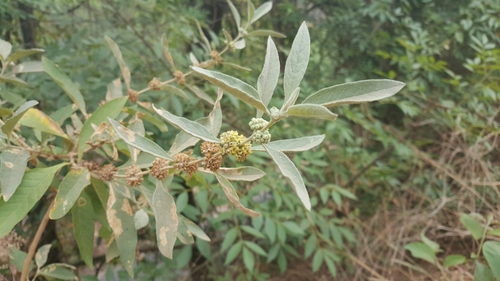
Its leaves are arranged alternately along branches, and measure 30–110 mm (1–4 in) in length.
Subspecies Leaf Variation
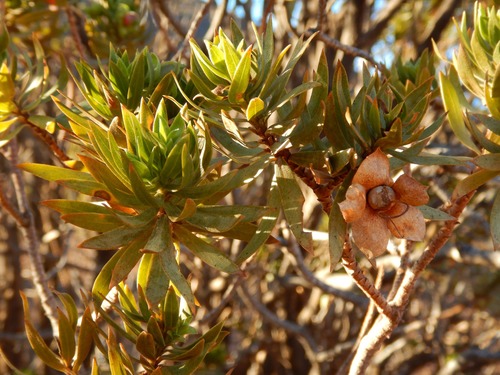
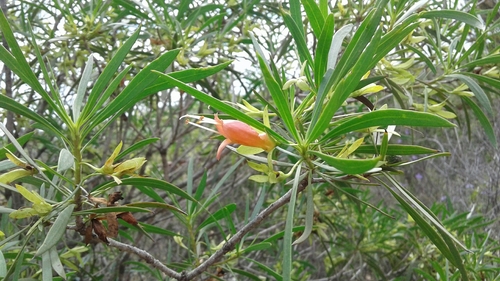
Leaf width and shape differ between the two recognised subspecies: the autonymic subspecies Eremophila oldfieldii subsp. oldfieldii has thin, flat leaves that are narrow lance-shaped to elliptic and 3–9.5 mm (0.1–0.4 in) wide, while Eremophila oldfieldii subsp. angustifolia has linear to almost cylindrical, thick, fleshy leaves that are 1.1–2.5 mm (0.04–0.1 in) wide.
Flower Stalk Characteristics
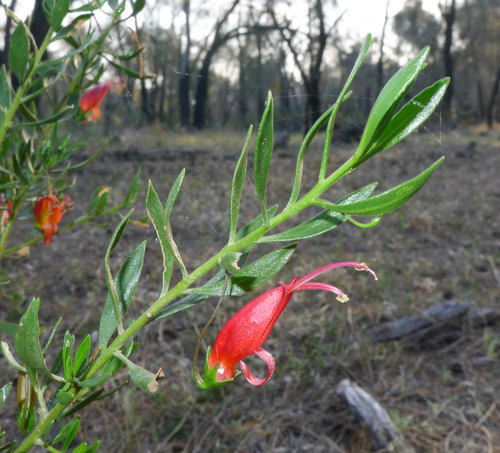
Flowers are produced singly in leaf axils, growing from a flattened, S-shaped, hairless stalk that is 8–35 mm (0.3–1 in) long.
Sepal Characteristics
This species has five oblong to lance-shaped sepals that are 8–35 mm (0.3–1 in) long and green or brown in colour.
Petal Structure
Petals are 18–40 mm (0.7–2 in) long and joined at their lower end to form a tube.
Petal Coloration and Hairiness
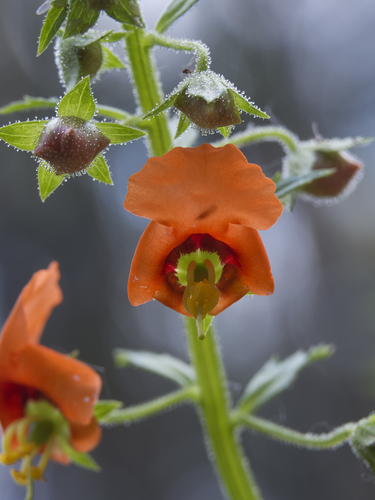
The petal tube is red to orange-yellow and hairless on the outer surface, while the edges and inner surface of the petal lobes are covered with glandular hairs.
Stamen Characteristics
The four stamens extend past the end of the petal tube.
Flowering Period
Flowering occurs between May and October.
Fruit Characteristics
After flowering, the plant produces almost spherical, wrinkled, hairless fruits that are 3–5 mm (0.1–0.2 in) long and have a papery covering.
Subspecies oldfieldii Habitat and Range
Subspecies oldfieldii is a common, widespread eremophila that grows in clay, loam, or calcareous sand, and occurs between Wongan Hills and Shark Bay in Western Australia’s Avon Wheatbelt, Carnarvon, Coolgardie, Geraldton Sandplains, Murchison, and Yalgoo biogeographic regions.
Subspecies angustifolia Habitat and Range
Subspecies angustifolia grows in rocky locations between Kalgoorlie and Cue, in the Avon Wheatbelt, Coolgardie, Geraldton Sandplains, Great Victoria Desert, Murchison, and Yalgoo biogeographic regions of Western Australia.
Horticultural Aesthetic Value
In horticulture, the bright red flowers of this large shrub contrast distinctly against its dark green leaves.
Horticultural Hardiness and Uses
It is a hardy plant that has been successfully grown in eastern Australia, and can be used as a windbreak or screening plant.
Propagation and Growing Conditions
It can be propagated from cuttings, and grows well in a wide range of soils in either full sun or partial shade.
Drought and Frost Tolerance
It is very tolerant of drought, but may be damaged by severe frosts.