About Myoporum laetum G.Forst.
Nomenclature and Growth Habit
Myoporum laetum G.Forst., commonly called ngaio, is a fast-growing evergreen shrub or small tree.
Size and Dimensions
It can sometimes reach 10 metres (30 ft) in height, with a trunk up to 0.3 metres (1 ft) in diameter, or spread as wide as 4 metres (10 ft).
Growth Form
Young plants are typically dome-shaped, but older specimens become distorted as branches break off.
Bark Characteristics
The bark of mature ngaio is thick, corky, and furrowed.
Leaf Shape and Size
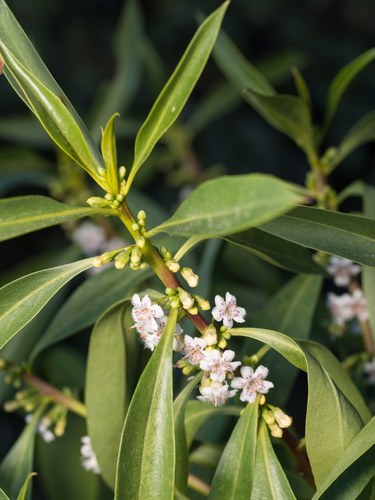
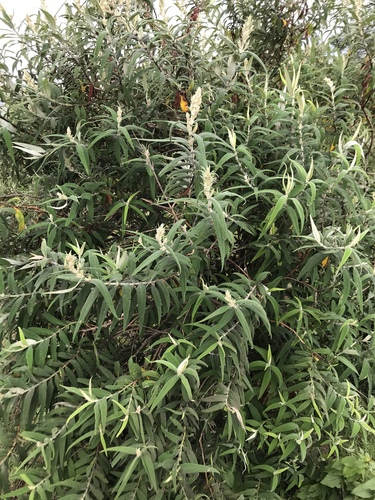
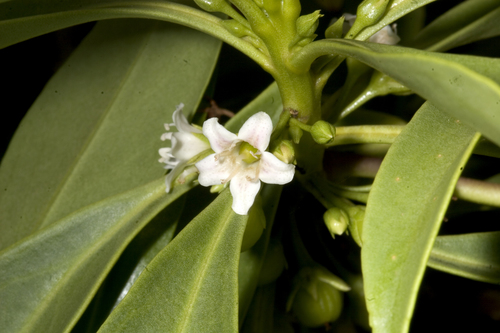
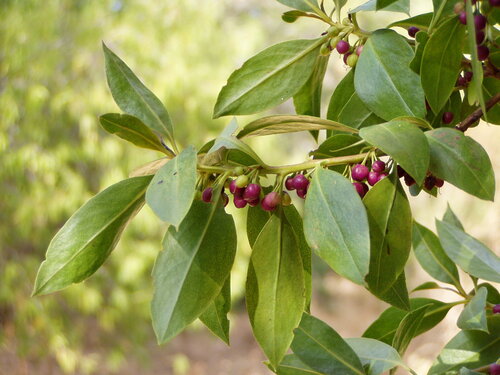
Its leaves are lance-shaped, usually between 52–125 millimetres (2–5 in) long and 15–30 millimetres (0.6–1 in) wide.
Leaf Surface and Margins
Leaves have many translucent dots, and small serrations along approximately the outer half of their edges.
Flower Inflorescence
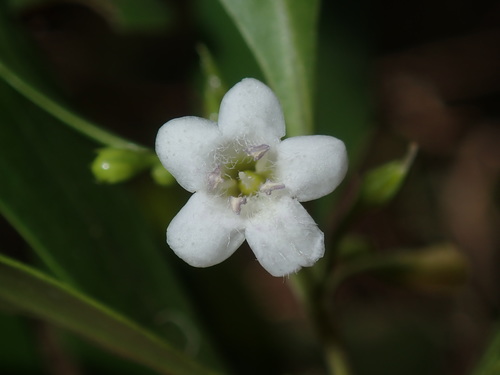
Ngaio produces white flowers marked with purple spots, borne in groups of 2 to 6 on stalks 7–15 millimetres (0.3–0.6 in) long.
Flower Sepals and Petals
Each flower has 5 egg-shaped, pointed sepals and 5 petals that join at the base to form a bell-shaped tube 3.5–4.5 millimetres (0.1–0.2 in) long.
Flower Diameter
The petal lobes are 4.5–5.5 millimetres (0.18–0.22 in) long, giving the flower an overall diameter of 15–20 millimetres (0.6–0.8 in).
Flower Reproductive Parts
Four stamens extend slightly beyond the petal tube, and the ovary is superior with 2 locules.
Flowering Period and Fruit
Flowering occurs from mid-spring to mid-summer, after which plants produce a bright red drupe fruit 6–9 millimetres (0.2–0.4 in) long.
Native Range and Habitat
Ngaio grows naturally in coastal areas of New Zealand, including the Chatham Islands, and occurs in lowland forest.
Stand Composition
It sometimes grows in pure stands, and other times grows alongside other species such as nīkau (Rhopalostylis sapida).
Introduced Range
Myoporum laetum has been introduced to several other countries, including Portugal, South Africa, and Namibia.
Invasive Status
The California Exotic Pest Plant Council lists it as an invasive exotic species.
Leaf Toxicity
The leaves of ngaio contain the liver toxin ngaione, which can cause sickness or death in livestock such as horses, cattle, sheep, and pigs.
Traditional Insect Repellent Use
Māori people traditionally rubbed ngaio leaves on their skin to repel mosquitoes and sandflies.
Traditional Medicinal and Food Uses
Leaf buds and inner bark are used in traditional rongoā Māori medicinal practices to soothe stomach pain or sore gums, and the berries were occasionally eaten as a traditional food source.
Consumption Warning
Due to the presence of the toxin ngaione, consumption of ngaio plant parts is not recommended.
Early European Settler Use
Early European settlers to New Zealand used ngaio oil as a sheep dip to protect sheep from parasites.