About Eremophila willsii F.Muell.
Growth Habit
Eremophila willsii is an erect shrub that can sometimes be compact, or other times open and spindly. It grows to a height between 0.45 and 1.5 metres (1 to 5 feet), and its branches are sticky because they produce large amounts of resin.
Leaf Arrangement
Its leaves are arranged alternately along the branches, and are either glabrous or hairy depending on the subspecies. Most leaves are 10–30 mm (0.4–1 in) long and 4–11 mm (0.2–0.4 in) wide, and often have serrated margins.
Leaf Variability
Leaf characteristics are very variable overall, but the most common shape ranges from narrow elliptic to egg-shaped; leaves are sometimes clustered and overlapping, and other times scattered. Intergrading between the two subspecies has been observed in the Northern Territory.
Flower Stalks
Flowers are borne singly or in groups of up to 4 in leaf axils, on stalks that are mostly 5.5–15 mm (0.2–0.6 in) long and usually densely hairy. There are 5 overlapping, egg-shaped to lance-shaped sepals, which are mostly 10–15 mm (0.4–0.6 in) long.
Sepal Traits
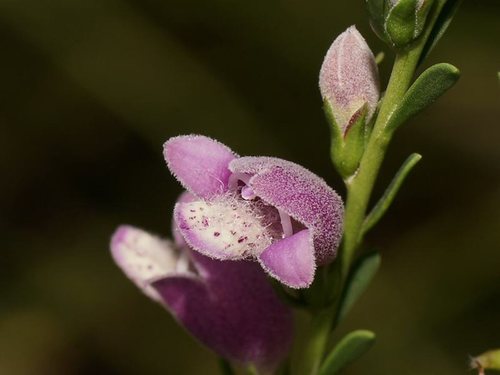
Like leaves, sepals may be hairy or glabrous depending on the subspecies. The petals are 17–28 mm (0.7–1 in) long, and joined at their lower end to form a tube.
Petal Features
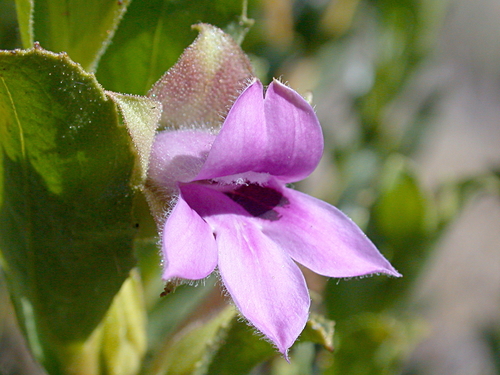
The petal tube ranges in colour from pinkish to deep pinkish-purple or lilac, and has two prominent dark purplish bands inside the tube. The outer surface of the tube and its lobes is more or less hairy, while the inner surface of the lobes is glabrous, and the inside of the tube is filled with long, soft hairs.
Stamens and Flowering Period
All 4 stamens are fully enclosed within the petal tube. Flowering occurs between May and October, and is followed by the production of fruit.
Fruit Characteristics
The fruit are narrow oval-shaped to cone-shaped with a pointed end, 3.5–4.5 mm (0.14–0.18 in) long, and have a hairy surface.
Subspecies willsii Distribution
In terms of distribution and habitat, subspecies willsii occurs in the south-west of the Northern Territory and adjacent areas of South Australia, where it grows on red sand plains, sand dunes, and the swales between dunes. It is also found in the Central Ranges biogeographic region of Western Australia.
Subspecies integrifolia Distribution
Subspecies integrifolia is widespread across sand dune systems in the southern part of the Northern Territory, western South Australia, and the Central Ranges, Gibson Desert, and Great Victoria Desert biogeographic regions of Western Australia. There is a single record of this subspecies from far western Queensland.
Horticultural Traits
Eremophila willsii is cultivated for horticultural use. It is often a naturally spindly shrub, but its striking flowers compensate for this growth form.
Propagation Methods
It can be propagated from cuttings grown in sand, especially when provided with bottom heat and intermittent mist.
Cultivation Requirements
It grows best in well-drained soil in a sunny position, rarely requires watering even during long dry spells, and is moderately frost tolerant.