About Bothriechis schlegelii (Berthold, 1846)
Common Name and General Classification
Bothriechis schlegelii, commonly called the eyelash viper, is a relatively small species of pitviper.
Size and Sexual Size Dimorphism
Adult individuals measure between 55 and 82 cm (22 to 32 in) in total length; females are longer and have more size variation than males, which grow to a maximum of 69 cm (27 in) long.
Head and Eye Morphology
This species has a wide, triangular head and eyes with vertical pupils.
Dentition and Sensory Organs
Like all pit vipers, it is solenoglyphous: it has large, hypodermic needle-like fangs at the front of the upper jaw that fold back when not in use, and it has heat-sensitive pit organs located on each side of the head between the eye and the nostril.
Eyelash-like Supraocular Scales
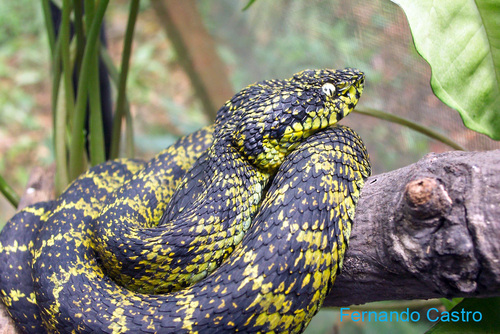
Its most notable identifying feature, which gives the species its common name, is a set of modified scales above the eyes that resemble eyelashes.
Function of Modified Supraocular Scales
These modified scales are thought to help with camouflage by breaking up the snake’s outline among the foliage where it hides.
Color Morphs and Sexual Monomorphism
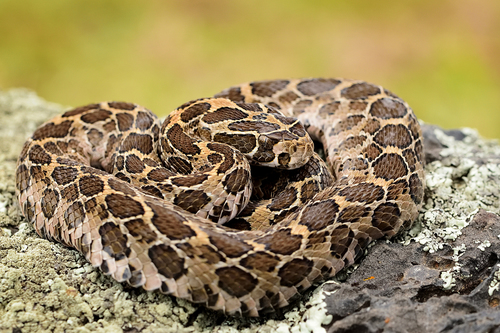
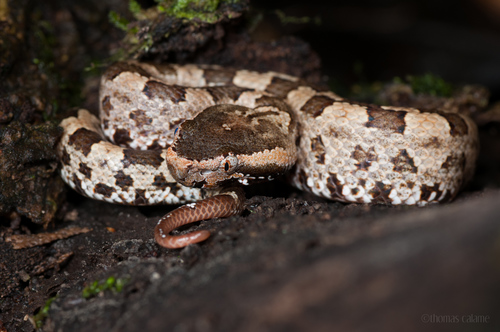
The eyelash viper occurs in a wide variety of color morphs, and no external physical features can be used to distinguish males from females.
Former Pre-2024 Geographic Range
Before a 2024 systematic taxonomic revision of the species, it was thought to have a geographic range extending from southern Mexico to northwestern South America.
2024 Taxonomic Revision Outcome
The revision reclassified many populations across this former range as distinct separate species.
Revised Current Geographic Range
Though these new species are very closely related to B. schlegelii, the revised range of B. schlegelii sensu stricto is restricted to Colombia, primarily in highland regions.
Sexual Maturity Age
Eyelash vipers reach sexual maturity at around two years of age.
Reproductive Mode and Breeding Period
This is an ovoviviparous species, and it reproduces year-round in warm environments.
Gestation and Internal Development
Females carry eggs for approximately six months before the eggs hatch internally, where the young finish their development.
Pregnant Female Traits
Pregnant females have enlarged lower abdomens, and they may stop eating during the later stages of pregnancy.
Brood and Offspring Characteristics
A typical brood consists of 2 to 20 live-born young, each 15 to 20 cm (6 to 8 in) long and physically similar to adult individuals.
Male Courtship Ritual
During courtship, two males engage in a ritual called the "dance of the adders" that can last for hours: the two males posture and intimidate one another in an upright, cobra-like stance, until one is pushed away or falls to the ground.
Mating System and Timing
Eyelash vipers are polygynous, and mating usually takes place at night.