About Botaurus pinnatus (Wagler, 1829)
Taxonomy and Common Name
Botaurus pinnatus (Wagler, 1829), commonly called the pinnated bittern, is a large heron species.
Size and Weight
It measures 25–30 inches (64–76 cm) long, with a body weight ranging from 554 to 1,157 grams (1.2 to 2.6 pounds); males are typically considerably heavier than females.
Sexual Dimorphism Basics
The sexes have similar plumage, but females are smaller than males, and have brown rather than black tail feathers.
Overall Plumage Coloration
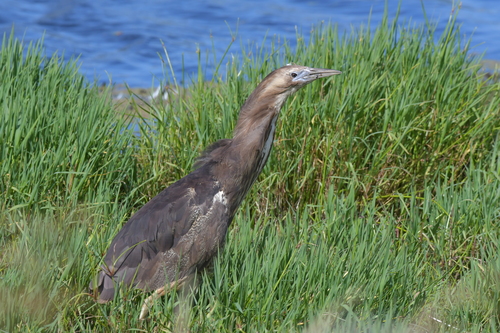
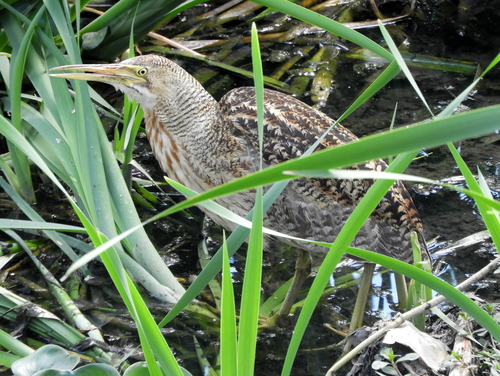
Both adult and immature pinnated bitterns are generally buffy overall, with heavy cryptic markings. Juveniles tend to have a slightly more reddish base body color.
Neck Markings
The throat is plain unmarked white, the foreneck is white with broad pale brown streaks, and the rest of the neck is buff with thin black barring.
Torso Markings
The breast and belly are white with broad pale brown streaks, while the back is buff, with heavy black streaks and barring.
Tail and Flight Feathers
Tail feathers are black in males and brown in females. Slate-grey flight feathers create a noticeable two-toned pattern when the bird is in flight.
Bill Characteristics
The bill is stout and strong, generally yellowish with a dark dusky upper mandible.
Facial Features
Bare facial skin is bright yellow, with a brown line running across the lores.
Leg and Iris Color
The legs are greenish-yellow, and the iris is yellow.
Alternate Common Name
The species is also sometimes called the South American bittern, but this alternate name is misleading because the species ranges as far north as southern Mexico.
Geographical Distribution
Its distribution extends from the Atlantic slope of southeastern Mexico to northern Argentina, though there are very few recorded sightings in Guatemala and Honduras.
Elevation Range
It occurs mostly in low-lying areas, but has been recorded at up to 8,500 feet (2,590 m) above sea level in the Cordillera Oriental of Colombia.
General Habitat Types
It inhabits a variety of freshwater environments, including dense reed beds, lake shorelines, flooded tall-grass pastures, marshes, and overgrown ditches.
Dominant Habitat Vegetation
Vegetation in its habitat is typically dominated by tall sedges (Cyperaceae), water hyacinth (Eichornia), rushes (Juncus), common reeds (Phragmites), or cattails (Typha).
Anthropogenic Habitat Use
It will also use rice (Oryza) and sugarcane (Saccharum) plantations.
Activity Pattern
The pinnated bittern is mostly nocturnal.
Social Behavior
While it is generally solitary, it will gather in small loose groups at preferred feeding locations.
Alarm Response
When alarmed, it typically freezes in place with its body crouched low, and its head held vertically raised just enough to see. It usually only flushes when approached very closely.
Population Assessment Status
Neither population size nor overall population trend has been estimated for this species.
Conservation Status
Due to its broad range, however, the IUCN classifies it as a species of Least Concern.
Diet Composition
The pinnated bittern has a varied diet that includes fish (such as eels), reptiles, amphibians, chicks, arthropods, molluscs, worms (including leeches), and small mammals (even young common marmosets, Callithrix jacchus).
Feeding Behavior
It typically ambushes all of its prey. It is a patient hunter, often standing motionless for long periods while waiting for prey to move within striking range.