About Boleophthalmus boddarti (Pallas, 1770)
Terrestrial Locomotion
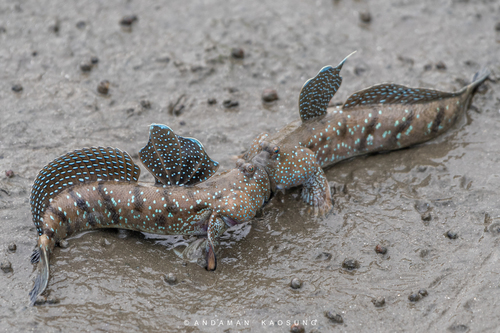
Like other mudskippers, Boleophthalmus boddarti can move on land. It uses its pectoral and pelvic fins to travel across the surface of tidal flats within its native range during low tide.
Coloration and Patterning
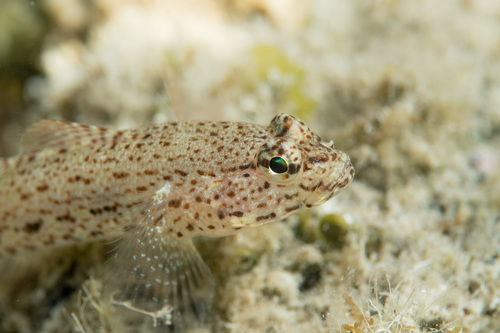
This fish has a bold, distinct patterning: rows of blue spots run along its flanks and cheeks, and dark bands extend down its body.
General Distribution
B. boddarti is distributed across the Indo-Pacific region. Its range extends from India in the west to Papua New Guinea in the east. Additional populations are found along China's coastline in the north, and in Sulaibikhat Bay, Kuwait, in the Persian Gulf.
Sympatric Species
In Malaysia and Sumatra, this species lives in sympatry with the closely related species Boleophthalmus pectinirostris. In India, it lives in sympatry with the closely related Boleophthalmus dussumieri.
Courtship Behavior
For reproduction, male B. boddarti jump to attract females to spawn inside their burrows.
Spawning Season Sex Ratio
A study conducted in Trần Đề district, Sóc Trăng province, Vietnam found that the sex ratio of B. boddarti during spawning season is approximately 1:1 male to female. This matches the sex ratio of the goby species Pseudapocryptes elongatus, and differs from some other regional goby species, where females typically have a higher catch rate than males.
Gonad Development Period
The same study found that ovary and testes development in B. boddarti occurs over four months, from July to October.
Spawning Frequency
Mature gonads hold gametes at multiple stages of development, which indicates that B. boddarti spawns multiple broods of offspring across three months, from August to October in the mid-wet season.
Sexual Maturity Size
The median body length of B. boddarti at sexual maturity is 11.52 centimetres (4.54 in).
Female Fecundity Factors
As larger females grow bigger and heavier later in the spawning season, they release larger, more numerous eggs, and have high fecundity. In the Sóc Trăng province study, individual female B. boddarti were found to release 9,800 to 33,000 eggs per breeding season.
Pollution Impact on Fecundity
However, females lay fewer eggs in more polluted environments: one study recorded 2,100 to 12,300 eggs per female in polluted creeks in Mumbai, India.
Human Consumption and Fisheries
B. boddarti is edible, and is occasionally caught and eaten by humans, though it is not targeted by commercial fisheries. The species is sometimes sold at local markets within its native range. It is commercially important in Vietnam and Thailand.