About Basilinna xantusii (Lawrence, 1861)
Scientific Classification and Total Length
Xantus's hummingbird (scientific name Basilinna xantusii (Lawrence, 1861)) measures 8.5 to 9.5 cm (3.3 to 3.7 in) in total length.
Weight
Males have an average weight of 3.5 g (0.12 oz), while females average 3.4 g (0.12 oz).
Bill Length
Both sexes have straight bills approximately 1.7 cm (0.67 in) long.
Male Bill Coloration
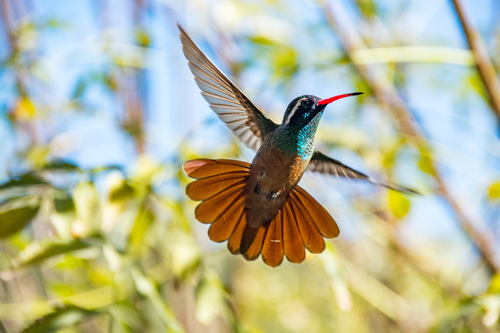
Male bills are red with a black tip.
Female Bill Coloration
For females, the maxilla is black with a pinkish base, and the mandible is pinkish red with a black tip.
Male Crown and Upperparts
Male Xantus's hummingbirds have a golden green to emerald green crown, nape, and upperparts, with rufous edging on their uppertail coverts.
Male Head and Throat Coloration
Their forehead and chin are black, their face is mostly black with a wide white stripe behind the eye, and their throat is iridescent emerald green.
Male Underparts Coloration
Their underparts are cinnamon, with some green mottling on the flanks and pale cinnamon undertail coverts.
Male Tail Characteristics
Their tail is rufous chestnut: the innermost pair of tail feathers have wide iridescent green edges, and the remaining four pairs have thin green edges.
Female Head and Upperparts
Females have a blackish brown face with a pale buffy stripe behind the eye. Their forehead is dull brownish, and their upperparts are iridescent golden green with some rufous edging on the uppertail coverts.
Female Underparts Coloration
All of their underparts, including the throat and undertail coverts, are pale to medium cinnamon.
Female Central Tail Feathers
On the female's tail, the central pair of feathers are golden green with a rufous shaft.
Female Outer Tail Feathers
The other four pairs are dark rufous that pales toward the end, with a black and bronzy green band near the end and thin white tips.
Core Distribution
This species is distributed from central Baja California south to the tip of the Baja California peninsula.
Vagrant Records
It has also been recorded as a vagrant: twice in California and once in British Columbia.
Habitat and Elevation Range
It inhabits arid scrub, oak, and pine-oak woodlands at elevations between 150 and 1,500 m (490 and 4,900 ft), and it also occurs in coastal desert, gardens, and at feeding stations.