About Doricha eliza (R.Lesson & Delattre, 1839)
Common Name and Taxonomy
Doricha eliza, commonly known as the Mexican sheartail, is a tiny hummingbird species.
Adult Weight
Adults weigh only 2.4 to 2.6 g (0.085 to 0.092 oz).
Shared Morphological Traits
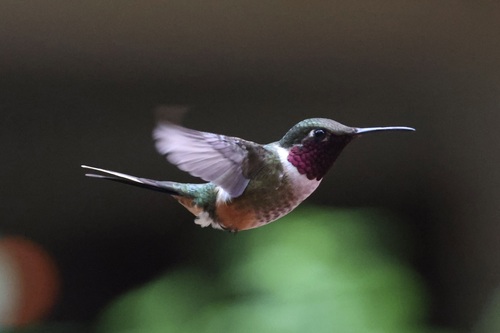
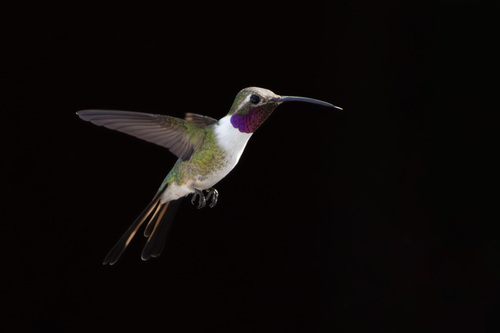
All Mexican sheartails share a long, curved black bill, a dull green crown, and bronzy-green nape and upperparts.
Sexual Dimorphism
This species shows clear sexual dimorphism.
Male Size and Plumage
Males measure 9 to 10 centimetres (3.5 to 3.9 in) long including the tail, have a white line behind the eye, a pink-purple throat with a white band below, and dull green underparts that are clearer on the median belly, with feathers covering the undertail.
Male Tail Structure
The male’s tail is long and deeply forked, usually held closed when at rest; his inner tail feathers are green, and the rest are black with cinnamon inner margins.
Female Size and Head Markings
Females are 8.5 to 9 cm (3.3 to 3.5 in) long, have a whitish face with a blackish stripe behind the eye.
Female Body Plumage
Their throat, chest, and belly are whitish, with cinnamon tinges on the sides.
Female Tail Structure
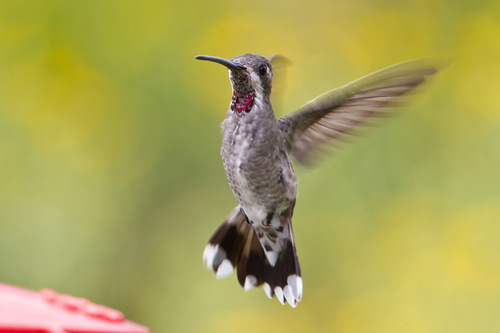
Females have a shorter forked tail; the outer tail feathers are reddish with a subterminal black band and white tips.
Immature Appearance
Immature individuals are similar in appearance to females.
Distribution Range
This species is found only in Mexico, where it occurs in two separate disjunct populations: one in central Veracruz, and the other in the northern coastal area of the Yucatan Peninsula.
Natural Habitats
Its natural habitats include subtropical or tropical dry forest, subtropical or tropical dry shrubland, mangroves, rural gardens, and urban areas.
Mangrove Habitat Example
One documented example of its mangrove habitat is the Petenes mangroves ecoregion on the Yucatán Peninsula.
Conservation Threat
The species is currently threatened by habitat loss.