About Tringa flavipes (J.F.Gmelin, 1789)
Species Classification
The lesser yellowlegs (scientific name: Tringa flavipes (J.F.Gmelin, 1789)) is a medium-large shorebird.
Body Measurements
It measures 23–25 cm (9.1–9.8 in) in total length, has a wingspan of 59–64 cm (23–25 in), and weighs 67–94 g (2.4–3.3 oz).
Sexual Dimorphism
Males and females are similar in both plumage and overall size.
Breeding Plumage
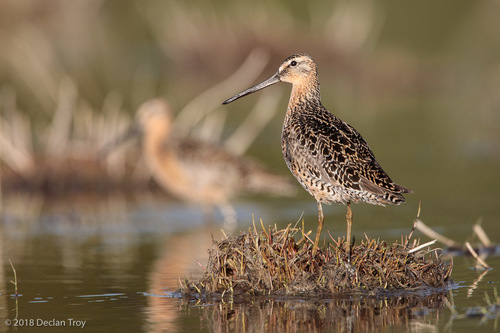
In breeding plumage, the upperparts are mottled with gray-brown, black, and white, while the underparts are white with irregular brown streaking on the breast and neck.
Non-breeding Plumage
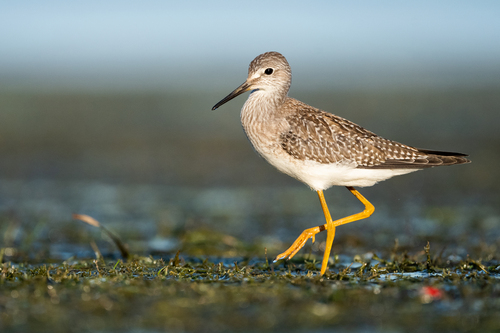
In non-breeding plumage, the upperparts are a more uniform gray-brown.
Leg Color
The legs are yellow.
Bill Characteristics
Compared to the greater yellowlegs, the lesser yellowlegs has a shorter bill that is visually about the same length as the head, slim, straight, and uniformly dark.
Body Markings
Its breast is streaked, and the flanks have fine short markings.
Taxonomic Relationships
While this species looks similar to the larger greater yellowlegs, it is more closely related to the much larger willet; the fine, clear, dense pattern on the neck of breeding-plumaged birds reflects this actual relationship.
Vocalization
The call of the lesser yellowlegs is softer than the greater yellowlegs' call.
Breeding Range
For distribution and habitat, the lesser yellowlegs breeds across interior Alaska and northern Canada, extending east to central Quebec. Its breeding range lies mainly between 51° and 69° N latitude in suitable wetland habitats.
Migratory Status
The lesser yellowlegs is a highly migratory bird.
Winter Range (North America)
During winter, lesser yellowlegs occur on the Atlantic coast of North America from New Jersey southward, along the Pacific coast as far north as San Francisco Bay, and throughout the coastal regions of the Gulf of Mexico and the Gulf of California.
Winter Range (Central and South America)
They are widely distributed across Mexico, Central America, South America, and the Antilles, where the largest populations spend the winter. Smaller numbers also winter inland across this range.
Vagrant Occurrences
This species is a regular vagrant to western Europe and other areas; around five individuals arrive in Great Britain each year, mostly between August and October, with occasional individuals overwintering.
Breeding Habitat
Their breeding habitat is clearings near ponds in the boreal forest region from Alaska to Quebec.
Foraging Location
For feeding, lesser yellowlegs forage in shallow water or on land.
Diet
They primarily eat gleaned invertebrates including flies, beetles, water boatmen, and mayflies, as well as small fish, crustaceans, aquatic worms, molluscs such as snails, spiders, and seeds.
Foraging Behavior
They are very active while foraging, moving quickly with a high-stepping gait and their neck outstretched, to pick at prey with quick jabs of the bill. Less often, they probe into mud or sweep their bill back and forth through water. They sometimes forage at night.