About Balistes polylepis Steindachner, 1876
Scientific Name and Size
The finescale triggerfish, scientifically named Balistes polylepis Steindachner, 1876, has a maximum published total length of 76 cm (30 in), while its typical total length is 50 cm (20 in).
Body Shape
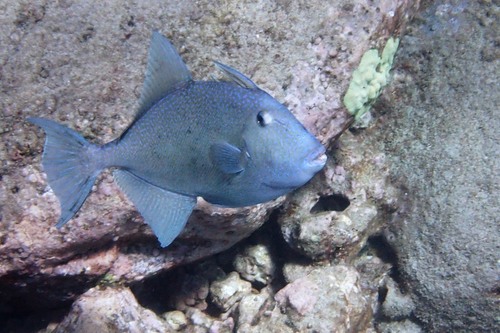
This species has robust, moderately deep, laterally compressed, oblong-shaped bodies.
Head and Mouth Features
A distinct groove runs from below the eye to just above the nostril, and it has a small forward-facing mouth that holds strong jaws. Each jaw has 8 large outer teeth; inner jaw teeth are notched, with the largest inner teeth located at the center of the jaw.
Gill Slit Position
The gill slit is short and positioned in front of the base of the pectoral fin.
Dorsal Fin Structure
The dorsal fin has 3 spines: the first spine can lock in an upright position, and the second spine is half the length of the first. There are 26 to 28 branched soft rays in the dorsal fin, 24 to 26 branched soft rays in the anal fin, and 13 to 15 branched soft rays in the pectoral fins.
Caudal Peduncle Features
The caudal peduncle is laterally compressed, and lacks spines, tubercles or ridges.
Caudal Fin Structure
The caudal fin is concave or doubly concave, with elongated lobes.
Pelvic Fin Structure
Pelvic fins are vestigial, made up of four scales that form a case around the end of the pelvis.
Skin and Scale Characteristics
The skin is thick and leathery, covered in plate-like scales arranged in regular diagonal rows. The entire snout is covered in scales. Large bony scales behind the gill slit form a tympanum.
Lateral Line
The lateral line is hard to distinguish.
Coloration
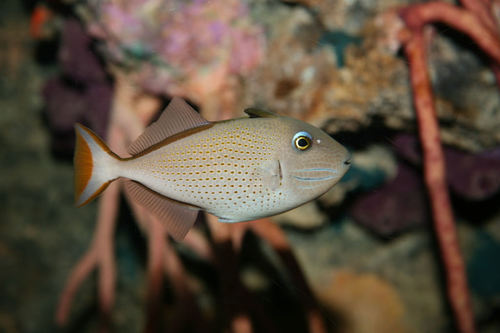
This fish is solid brown or solid gray, with no noticeable markings.
Core Distribution Range
Balistes polylepis is distributed in the Eastern Pacific Ocean from northern California south to central Chile, including offshore islands such as the Revillagigedo Islands, Cocos Island, Malpelo Island, and the Galápagos Islands.
Vagrant and Colonization Records
It occurs as a vagrant in Hawaii, and may currently be in the process of colonizing the Hawaiian archipelago; a single individual was recorded in the Marquesas Islands in 1999.
Habitat and Depth Range
It inhabits rocky reefs, boulder-covered slopes, and adjacent sandy areas at depths ranging from 3 to 50 m (9.8 to 164.0 ft).