About Odonus niger (Rüppell, 1836)
Common Name and Base Coloration
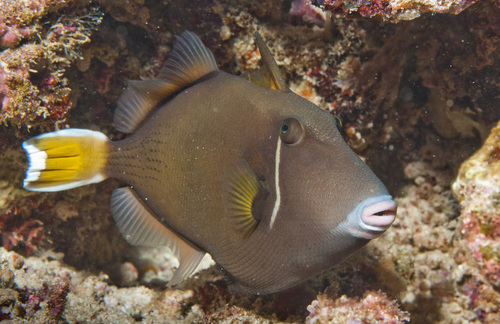
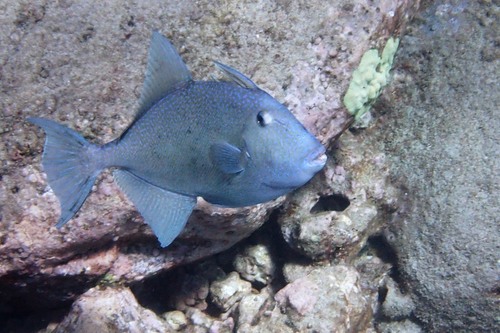
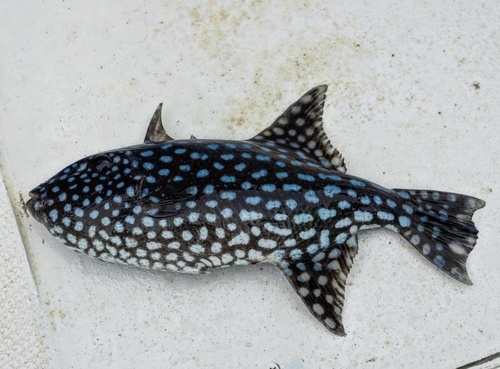
Odonus niger, commonly known as the redtoothed triggerfish, is typically deep blue or purple.
Head and Fin Markings
It has a light blue head with bluish-green markings, and glowing light blue margins on its tail lobes and fins.
Tail Shape
Like all members of the Balistidae triggerfish family, it has a lyre-shaped tail.
Mouth and Teeth Features
Its mouth often appears to be grinning, and it holds tiny, needle-sharp red teeth; two teeth in its upper jaw are visible even when its mouth is closed.
Temperament and Sound Production
This is one of the more peaceful species in the triggerfish family, though it can become more threatening as it ages, and is capable of producing a grunting-type sound.
Color Changing Ability
It can change its color depending on its mood, food, feeding conditions, and water quality, shifting between shades of purple, blue, and bluish-green.
Adult Size
Adults reach an average length of 9 to 12 inches, or 23 to 30 cm.
Fin Structure for Swimming
Its pectoral fins are quite small, so it mostly steers with its dorsal and anal fins.
Swimming Adaptations
This adaptation makes it highly maneuverable, and it uses these fins for a distinctive propeller-like style of propulsion that counts among the most unique swimming styles in the ocean.
General Distribution
The redtoothed triggerfish is found across the widespread Indo-Pacific Ocean and the Red Sea.
Detailed Range Extent
Its range extends from the east coast of Africa to the Marquesas and Society Islands, and reaches as far north as Southern Japan and as far south as Australia’s Great Barrier Reef.
Mating System
This species has distinct mating pairing.
Nesting Behavior
Individuals gather at mating grounds where males establish territories, then build nests to hold their eggs.
Egg Care and Guarding
Females care for the eggs, and both males and females guard the eggs until they hatch.
Breeding in Captivity
While they breed successfully in the wild, they cannot breed in aquariums.