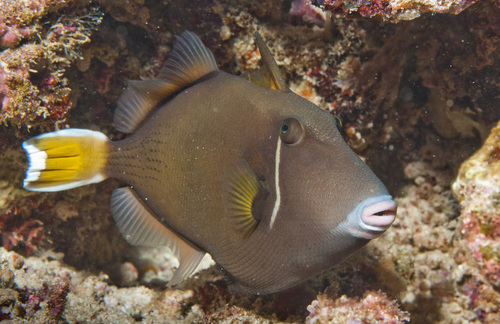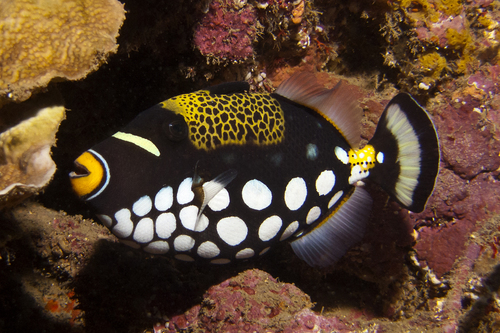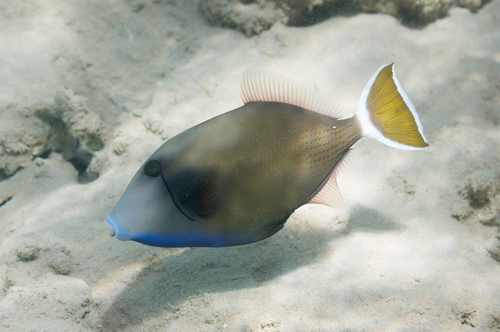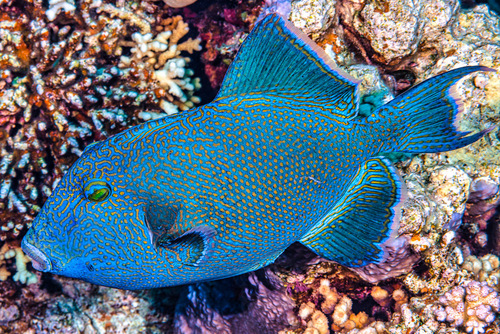
About Balistapus undulatus (Park, 1797)
Body Coloration
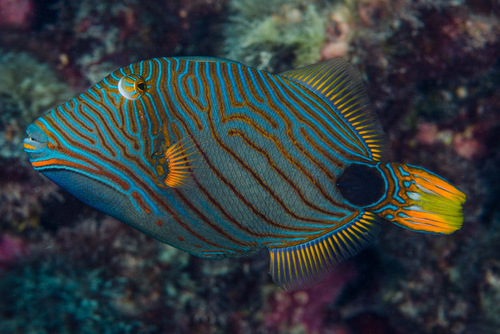
The orange-lined triggerfish, Balistapus undulatus, has a dark brown to dark green body marked with orange lines that begin behind the head and cover the entire body.
Maximum Length
It reaches a maximum body length of around 30 centimeters.
Body Shape
The species has a stocky, oval-shaped body that is compressed laterally.
Head Proportion
Its large head makes up about one third of its total body length.
Mouth and Teeth
The small mouth is positioned at the front of the head, and the fish has strong teeth.
First Dorsal Fin Structure
The first dorsal fin holds three spines, one of which is longer and stronger than the other two; this spine can be erected, and is held in a dorsal furrow when the fish is at rest.
Second Dorsal and Anal Fins
The second dorsal fin matches the anal fin in shape and size, and the anal fin sits symmetrically opposite the second dorsal fin.
Pelvic Fin Structure
The pelvic fin is reduced to a small ventral protrusion.
Additional Markings and Caudal Fin
Orange-lined triggerfish usually have a large black spot near their peduncular spines, and their caudal fin is orange.
Mature Male Morphology
Mature males are generally larger, lack a concave snout, and lose the orange lines on their snouts as they mature.
Female and Juvenile Morphology
Females and juveniles are smaller and have a concave snout.
Geographical Distribution
This triggerfish species is found in coral reef ecosystems, coral lagoons, and external reef slopes across the Indo-western Pacific, including waters off the coast of East Africa, the Red Sea, and Japan, where other balistoid fishes like filefish and leatherjacks also occur across the broader region.
Shelter Association
Individuals typically remain close to their burrows and dens within reef structures.
Habitat Versatility
Compared to other triggerfish species, the orange-lined triggerfish is more versatile in its habitat use within coral reefs.
Depth Range
It can be found at depths as great as 50 meters, though it prefers depths between 2 and 8 meters.
Age-Specific Depth Patterns
No link between reef area and depth has been observed for juveniles, while adult depth ranges vary by region, and the species overall has a broad distribution across reefs.
Substrate Preferences
Adults and juveniles also prefer different substrate types: adults favor rock and branching coral, while juveniles prefer softer surfaces.