About Andinobates bombetes (Myers & Daly, 1980)
Adult Size
Adult male Andinobates bombetes, commonly called the cauca poison frog, measure approximately 17.76 mm in snout-vent length, while adult females measure approximately 18.63 mm.
Dorsal Base Coloration
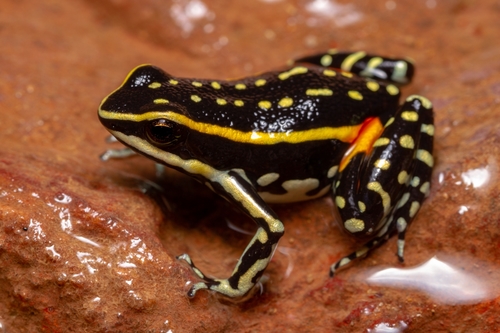
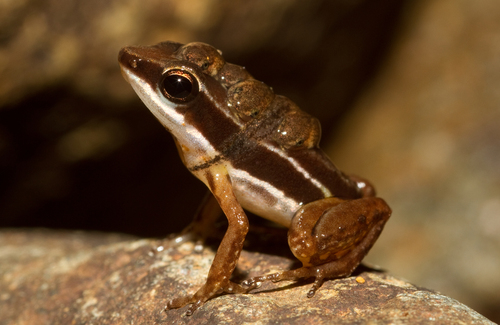
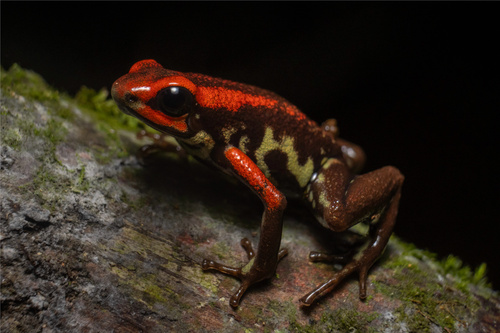
The base color of the dorsal skin is black or dark brown, with red or orange markings extending from the nose to the middle of the body, and sometimes all the way to the end of the body.
Dorsal Stripe Variation
In at least one recorded case, these stripes extend onto the front legs. There is an additional red or orange blotch on the head.
Body Side Coloration
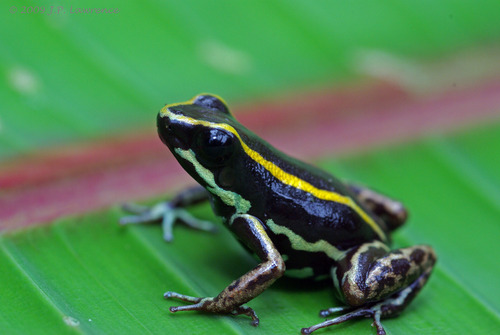
The sides of the body are black, even when the rest of the back is brown, and bear yellow or yellow-green spots.
Front Leg Coloration
The front legs may be red or orange, and are always the same color as the stripes on the back.
Upper Lip Coloration
The upper lip may match the color of the dorsal stripes, or be pale green mixed with some red.
Foot Dorsal Coloration
The dorsal surfaces of all four feet may have blue, green, or yellow coloring.
Toe and Foot Ventral Coloration
The toes of all four feet are light brown or gray, and the ventral surfaces of the feet are dark gray.
Foreleg Ventral Coloration
The ventral surfaces of the forelegs are black with lighter markings.
Head and Trunk Ventral Coloration
The ventral surfaces of the head and trunk may be black with green, yellow, or blue-green markings.
Mouth Interior Coloration
The tongue and inside of the mouth are dark gray.
Iris Appearance
The iris is such a dark brown that the pupil is difficult to distinguish.
Homing Ability
Compared to other previously studied poison frogs, the cauca poison frog has limited homing ability.
Native Habitat Type
Its natural habitats are montane and submontane cloud forests, located between 850 and 2300 meters above sea level.
Bromeliad Microhabitat Use
It relies on microhabitats provided by bromeliad plants, which hold pools of water in their leaves and near their leaf axils.
Disturbed Habitat Tolerance
This frog can tolerate disturbed habitats as long as these bromeliad plants are present there.
Egg Laying Location
Females lay eggs in leaf litter.
Male Parental Behavior
Males have been observed visiting egg clutches and carrying tadpoles on their backs.
Tadpole Habitat
After hatching, tadpoles swim in the water held by bromeliad plants.
Tadpole Morphology
Tadpoles are gray-brown, part of the tail is transparent, and they have large beaks.