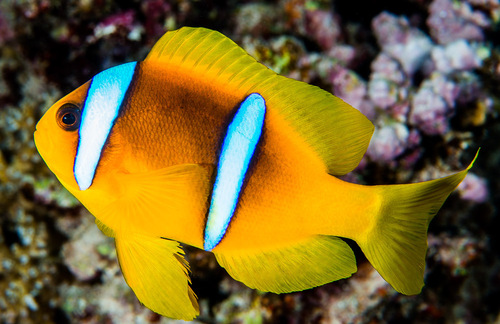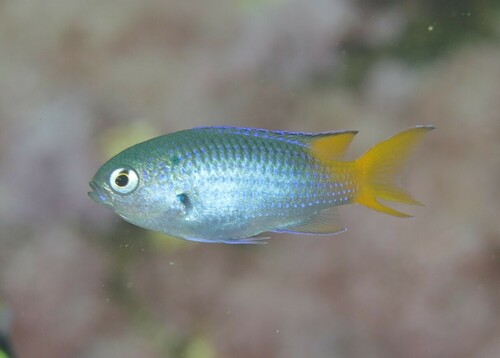
About Amphiprion percula (Lacepède, 1802)
Nomenclature and Size
Amphiprion percula (Lacepède, 1802), commonly called the orange clownfish, can reach a maximum length of 11 cm (4.3 in), with an average length of 8 cm (3.1 in).
Base Coloration
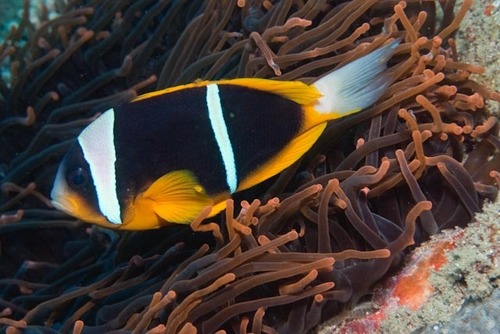
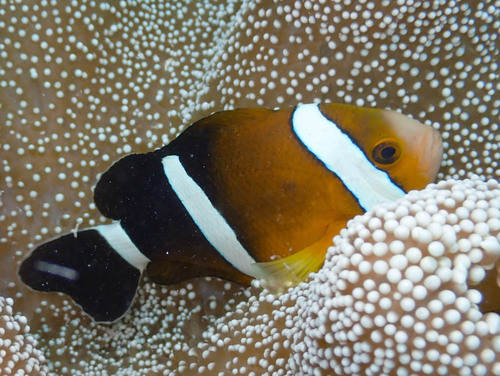
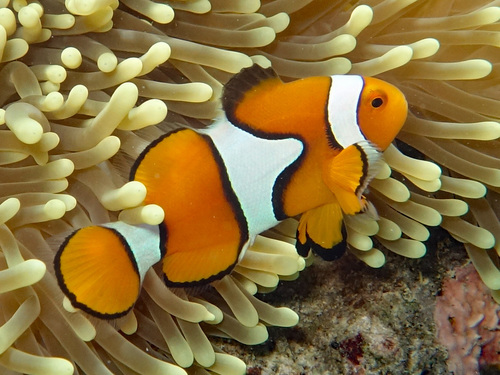
Individuals have bright orange bodies marked by three white bands, and there is no color difference between males and females.
White Band Placement
The front white band sits just behind the eye, the middle band runs straight down the center of the fish and has a forward-projecting bulge, and the rear white band sits near the caudal fin.
Fin Edging
Each fin is outlined with black edging of varying thickness.
Similar Species Confusion
This species is easily confused with the closely related ocellaris clownfish (A. ocellaris), which is sometimes called false percula clownfish or common clownfish due to its similar color and patterning.
Dorsal Spine Identification
The most reliable way to tell the two species apart is by counting spines in the first dorsal fin: A. percula almost always has 10 spines (rarely 9), while A. ocellaris almost always has 11 spines (rarely 10).
Fin Edging Species Difference
Unlike A. percula, A. ocellaris does not have thick black edging on its fins.
Heat Stress Body Shrinkage
Marine heatwaves negatively alter growth patterns in vertebrate species, and orange clownfish respond to this heat stress by shrinking their bodies.
Shrinkage Survival Correlates
The amount of shrinkage is shaped by an individual’s social rank and original size, and individuals that shrink more often alongside their breeding partner have higher survival rates during heatwaves.
Symbiotic Relationship Classification
A. percula is a species of specialized coral reef anemonefish that forms a symbiotic relationship with host sea anemones.
Geographic Range
It inhabits warm waters of the Pacific and Indian Oceans, found off northwest Australia, southeast Asia, and Japan.
Depth and Temperature Habitat
Both A. percula and its host anemones live in shallow waters, usually no deeper than 12 m, where water temperatures range between 25 and 28 °C.
Host Anemone Competition
Typically only one anemonefish species occupies a single host anemone, because one species will outcompete and exclude others from the same host.
Interspecific Aggression
If two anemonefish species try to share a host, they will act aggressively toward one another unless there is a large size difference between them.
Host Availability Impact
For this reason, the availability of nearby anemone hosts strongly controls A. percula’s recruitment and overall survival.
Primary vs Secondary Host Occupancy
Primary host anemones are frequently occupied by anemonefish, while secondary host anemones are occupied at much lower rates.
Host Anemone Distribution Limit
The distribution and availability of host sea anemones is limited by the photosynthetic activity of symbiotic algae that live in the anemones’ tentacles.
Secondary Host Use Condition
A. percula will only use secondary host anemones when there is a severe shortage of available primary hosts.
Microhabitat Sorting
When multiple anemonefish species share similar habitats, they sort themselves into smaller microhabitats based on the available anemone species.
Host Anemone Preference
Both A. percula and A. perideraion can live within the anemone Heteractis magnifica, but A. percula shows the strongest preference for the anemone Stichodactyla gigantea.
Papua New Guinea Census Data
A study conducted by Elliot & Mariscal in Madang, Papua New Guinea found that every censused H. magnifica anemone was occupied by either A. percula or A. perideraion.
Interspecific Shoreline Niche Partitioning
A. percula generally occupies anemones located near shore, while A. perideraion occupies anemones further offshore.
Unsuitable Anemone Criteria
A. percula will not occupy anemones that are in very shallow water or are too small.
Shallow Water Inhabitability Causes
Very shallow waters are uninhabitable for this species due to lower salinity, higher temperatures, and exposure during low tides.
Small Anemone Limitation
Small anemones also cannot provide enough protection from predators.
Symbiosis Mutual Benefit
In their symbiotic relationship, A. percula and its host anemone both benefit from the association.
Anemonefish Cleaning Behavior
A. percula cleans the host anemone by eating algae residue and zooplankton such as copepods and larval tunicates.
Predator Protection Mutualism
It also protects the anemone from predators that eat polyps and other anemone tissue, while the anemone protects A. percula from its own predators.
Shared Food Storage
A. percula will sometimes store pieces of food near the host anemone for later consumption, and in most cases the anemone will eventually eat this stored food.
Symbiosis Survival Outcome
This coexistence increases the survival chances of both partners.
Ocean Acidification Olfaction Hypothesis
Larval orange clownfish use their sense of smell to avoid predators, but some research has suggested that increased ocean acidification from rising carbon dioxide emissions may prevent larvae from telling predator odors apart from other scents.
Hypothesized Acidification Mortality Impact
This could make larvae more likely to be preyed upon, leading to higher population mortality.
Habitat Finding Acidification Risk
Impaired sense of smell could also make it harder for larvae to find suitable reef habitats under projected future high-CO2 conditions.
2020 Acidification Effect Reproducibility Critique
However, a 2020 paper published in Nature questioned these reported effects, stating that the observed impacts of ocean acidification on coral reef fish behavior are not reproducible, and behavioral changes are unlikely to be a major consequence for coral reef fishes in high-CO2 oceans.
2022 Meta-Analysis Effect Size Trend
A 2022 meta-analysis also found that the reported effect sizes of ocean acidification on fish behavior have dropped dramatically over a decade of research, with effects appearing negligible since 2015.
Decline Effect Example
This represents one of the most extreme examples of the decline effect in ecological research.
Reproductive Seasonality
Because A. percula lives in a warm-water environment, it can reproduce year-round.
Social Group Hierarchy Structure
Each social group is made up of one breeding pair and zero to four non-breeding individuals, with a strict size-based hierarchy: the breeding female is the largest individual, the breeding male is the second largest, and non-breeding males become progressively smaller down the hierarchy.
Protandry Sex Change Mechanism
This species exhibits protandry, meaning all individuals are born male, and will change sex to become female if the only existing breeding female dies.
Sex Change Succession
If the breeding female dies, the breeding male becomes the new breeding female, and the largest non-breeding male becomes the new breeding male.
Lunar Spawning Link
Spawning activity is linked to the lunar cycle: nighttime moonlight increases alertness in A. percula, which boosts interaction between males and females.
Pre-Spawning Courtship
Before spawning, males court females to attract them.
Courtship Behaviors
Courtship behaviors include extending fins, biting the female, chasing the female, and swimming rapidly up and down.
Spawning Nest Importance
The location of the spawning nest is critical for egg survival.
Fecundity
Depending on the female’s size, she lays between 400 and 1500 eggs per spawning cycle.
Breeding Female Lifespan
Breeding females typically hold their position for roughly 12 years, which is a relatively long lifespan for a fish of this size, consistent with other reef fish species.
Non-Breeder Presence Puzzle
It was long unclear why non-breeding individuals stay in these social groups.
Non-Breeder Reproductive Limitation
Unlike non-reproductive individuals in some other animal groups, non-breeding A. percula cannot get occasional breeding opportunities, because their gonads are not functional.
Non-Breeder Helper Role Absence
They also do not act as helpers at the nest, since their presence does not improve the breeding pair’s reproductive success.
Non-Breeder Queue Hypothesis
Recent research indicates non-breeders are simply waiting in a queue to inherit the breeding territory (the host anemone); non-breeders that associate with the breeding pair have a better chance of eventually gaining a territory than fish that do not reside with a group.
Rank Advancement Rules
An individual moves up in the queue only when it outlives at least one dominant individual, and rank advancement does not require the death of an individual’s immediate dominant.
Hierarchy Growth Impacts
Development from juvenile to adult is shaped by this hierarchical system, and growth is density-dependent.
Intragroup Aggression Patterns
Aggression occurs within these small groups, usually between males rather than between the breeding pair.
Growth Suppression Dynamics
The largest male suppresses growth of the next smallest male, and this cycle continues until the smallest fish is forced out of the host anemone.
Female Population Regulation
The breeding female ultimately regulates population size within the anemone, because the amount of space available for fish is directly proportional to the female’s size, which eventually stops growing.
Competitive Stunted Growth
This species is highly competitive, which leads to stunted growth in smaller individuals.
Rank Challenge Rarity
A fish could potentially challenge its dominant to move up in rank, but this depends on the two individuals having similar body sizes, and it is very rare because A. percula maintains consistent clear size differences between adjacent ranks.
Aquarium Temperament
In aquariums, however, this species is peaceful and adapts well to captive life.
Nest Placement Strategy
A. percula lays its eggs in a protected spot close to the host anemone, where the eggs can be guarded and parents can retreat to safety if threatened.
Nest Preparation Timing
Anemonefish usually lay their nests in the evening, after spending several days cleaning and inspecting the chosen site.
Wild Nest Site Preference
Preferred egg sites are flat or slightly curved rocks, or other objects the fish have moved near the anemone for nesting.
Captive Nest Site Preference
In captivity, clay pots and saucers are a popular nesting choice.
Egg Deposition Process
First, the female deposits eggs using her ovipositor, a whitish tube that extends from her belly, making a wiggling pass across the nest surface.
Egg Fertilization
The male then follows behind her to fertilize the eggs.
Egg Incubation Period
After multiple passes, the nest is complete, and eggs hatch 6 to 8 days after laying, shortly after sunset, usually on a very dark night.
Male Incubation Behavior
During incubation, the male guards the nest closely, constantly fanning the eggs to deliver oxygen and removing and eating any dead or damaged eggs before they can rot and harm healthy eggs.
Female Incubation Assistance
Females may sometimes help the male tend the nest.
Larval Dispersal Phase
When larvae hatch, they swim upward toward moonlight and out into the open ocean, where they drift with currents and feed on plankton for around a week.
Settlement and Life Cycle Closure
After metamorphosis, the still tiny clownfish return to the reef to search for a host anemone to settle in, and the cycle begins again.