About Amphiprion allardi Klausewitz, 1970
Taxonomic Identification
Allard's anemonefish (Amphiprion allardi Klausewitz, 1970) is a species of anemonefish, also called clownfish.
Anemone Symbiosis Overview
In the wild, all clownfish form symbiotic mutualisms with sea anemones.
Symbiosis Host Benefits
Clownfish are unaffected by their host anemone's stinging tentacles; the sea anemone protects the clownfish from predators, and provides food in the form of scraps left from the anemone's meals and occasional dead anemone tentacles.
Symbiosis Clownfish Benefits
In return, the clownfish defends the anemone from the anemone's own predators and parasites.
General Clownfish Size
Clownfish are small fish, with most species reaching 10–18 cm (3.9–7.1 in) in total length.
General Clownfish Coloration
Depending on the species, clownfish have an overall body color of yellow, orange, reddish, or blackish, and many species have white bars or patches.
Color Variation Drivers
Color variations between clownfish species most commonly correspond to geographic distribution, but can also vary based on individual sex, age, and host anemone.
General Clownfish Distribution
Clownfish as a group are found in the warmer waters of the Indian Ocean, Pacific Ocean, and Red Sea, in sheltered reefs or shallow lagoons.
Group Dominance Hierarchy
Clownfish groups follow a strict dominance hierarchy, with the largest and most aggressive individual being the female that holds the top position in the hierarchy.
Reproductive Strategy
Only one breeding male and one breeding female in a group reproduce, through external fertilization.
Hermaphroditism Trait
All clownfish are sequential hermaphrodites: they develop as males first, and mature into females later in life.
A. allardi Adult Coloration
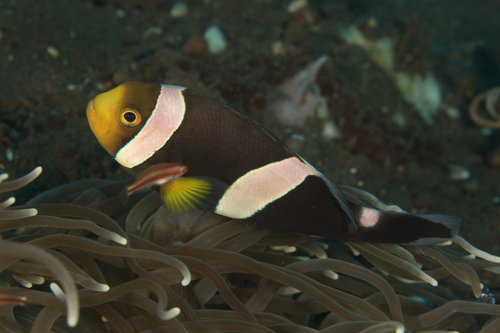
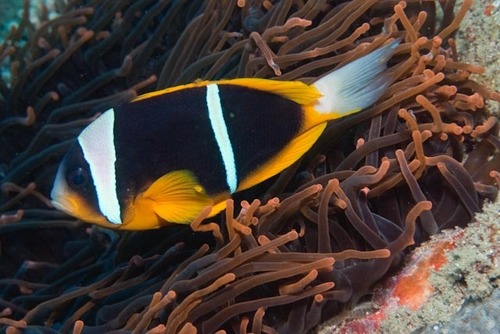
For A. allardi specifically, adult individuals are dark brown to black in color, with two white bars edged in black that encircle the body.
A. allardi Fin Coloration
The caudal fin is white, and all other fins are orange.
A. allardi Fin Ray Counts
This species has 10–11 dorsal spines, two anal spines, 15–17 dorsal soft rays, and 15–17 anal soft rays.
A. allardi Maximum Size
It reaches a maximum total length of 14 cm (5+1⁄2 in).
A. allardi Geographic Range
Allard's anemonefish is distributed in waters off east Africa, ranging between Kenya and Durban, and extends east to the Seychelles and Mascarene Islands.
A. allardi Habitat Association
Individuals are usually found near or within the tentacles of their host sea anemones.