About Amphiprion bicinctus Rüppell, 1830
Taxonomy and Common Name
Amphiprion bicinctus Rüppell, 1830, commonly called two-banded anemonefish, is a species of anemonefish, also known as clownfish.
Clownfish Symbiosis Overview
All clownfish are small fish that form symbiotic mutualisms with sea anemones in the wild.
Anemone Benefits to Clownfish
They are not affected by the stinging tentacles of their host anemone: the sea anemone protects clownfish from predators, and provides food in the form of scraps left from the anemone's meals, plus occasional dead anemone tentacles.
Clownfish Benefits to Anemone
In return, clownfish defend their host anemone from the anemone's own predators and parasites.
General Clownfish Size
Most clownfish reach total lengths between 10 and 18 centimetres (3.9 to 7.1 in).
General Clownfish Coloration
Depending on the species, clownfish have overall body colors that can be yellow, orange, reddish, or blackish, and many species have white bars or patches.
Intraspecific Color Variation
Color variations can occur within a single clownfish species, most commonly tied to the population's distribution, but also based on the individual's sex, age, and host anemone.
General Clownfish Habitat
Clownfish as a group inhabit warmer waters of the Indian Ocean, Pacific Ocean, and Red Sea, living in sheltered reefs or shallow lagoons.
Clownfish Dominance Hierarchy
Clownfish groups follow a strict dominance hierarchy: the largest and most aggressive individual in the group is female, and holds the top position in the hierarchy.
Clownfish Reproduction
Only one male and one female in each clownfish group reproduce, and they use external fertilization.
Clownfish Hermaphroditism
All clownfish are sequential hermaphrodites: they first develop as males, and become female once they reach maturity.
Amphiprion bicinctus Body Color
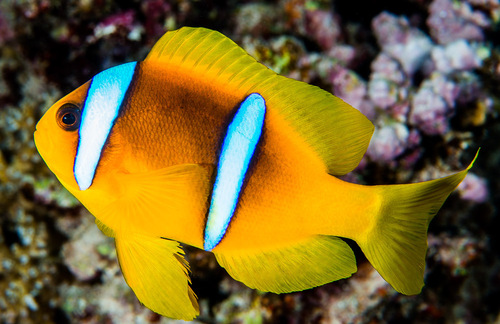
For Amphiprion bicinctus specifically, the fish's body ranges in color from yellow-orange to dark brown.
Amphiprion bicinctus Band Pattern
As its common name suggests, this species has two white bands or bars that each have black edges.
Amphiprion bicinctus Band Size Difference
The bar that runs across the head is considerably wider than the second band.
Amphiprion bicinctus Fin Morphology
This species has between 9 and 10 dorsal spines, 2 anal spines, 15 to 17 dorsal soft rays, and 13 to 14 anal soft rays.
Amphiprion bicinctus Size Dimorphism
Males of this species grow to a maximum length of 10 centimetres (3.9 in), while females grow to a maximum length of 14 centimetres (5.5 in).
Amphiprion bicinctus Distribution
This species is distributed in the Western Indian Ocean, the Red Sea, Socotra, and the Chagos archipelago.