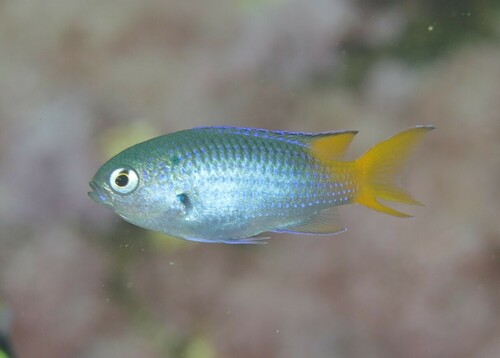
About Amphiprion ocellaris Cuvier, 1830
Size
The common clownfish, Amphiprion ocellaris, is a small fish that reaches a maximum length of 11 cm (4.3 inches).
Body Shape
It has a stocky, oval-shaped body that is laterally compressed, with a rounded overall profile.
Base Body Color
Body color ranges from orange to reddish-brown, though individuals from areas such as Australia’s Northern Territory may be black.
Body Stripe Pattern
The species has three vertical white stripes, each outlined by a fine black line. The first stripe sits directly behind the eye, the second runs through the middle of the body and widens forward into the center of the head, and the third encircles the caudal peduncle.
Fin Markings
All of the common clownfish’s fins are also outlined with a fine black line.
Similar Species Confusion
A. ocellaris is frequently mistaken for the closely related Amphiprion percula, which shares the same overall color and pattern at first glance.
Species Distinguishing Traits
The two species can be told apart by the thickness of their black outline markings: A. ocellaris also has a taller dorsal fin, and typically has 11 dorsal-fin spines, compared to 10 spines in A. percula.
Distribution
This species is distributed across the Eastern Indian Ocean and western Pacific Ocean, with additional recorded populations in Hawaii (USA, North America), Northern Australia, Southeast Asia, and Japan.
Habitat and Depth Range
Amphiprion ocellaris usually lives in small groups on outer reef slopes or in sheltered lagoons, at a maximum depth of 15 meters.
Symbiotic Relationship
It forms symbiotic relationships with three specific species of sea anemone: Heteractis magnifica, Stichodactyla gigantea, and Stichodactyla mertensii, and only inhabits these anemone species.
Reproductive Behavior Overview
The reproductive behavior of A. ocellaris matches that of all other anemonefish.
Mating System
It has a monogamous mating system, and both males and females show equal levels of aggression during the spawning process.
Group Reproductive Hierarchy
A reproductive hierarchy based on age and sex exists within A. ocellaris groups.
Diet Composition
Common clownfish are omnivores that feed on plankton and algae, with their specific diet including algae, copepods, and zooplankton.
Feeding and Social Hierarchy
Feeding access and behavior are shaped by the social hierarchy of A. ocellaris groups. Smaller, less dominant fish face aggression from larger, more dominant group members, leaving them with less energy to forage.
Foraging Risk for Smaller Individuals
These smaller fish also face greater danger when they leave their host anemone due to their small size.
Hierarchy Impact on Foraging
As a result, smaller fish generally eat less than dominant fish, and larger fish typically travel farther from the anemone to forage than smaller fish do.