About Ara ararauna (Linnaeus, 1758)
Ara ararauna (Linnaeus, 1758), commonly called the blue-and-yellow macaw, is one of the larger members of its family.
Adult Size
Adults reach a length of 81–91 cm (32–36 in) and weigh 1.0–1.5 kg (2–3 lb).
Upper Body Coloration
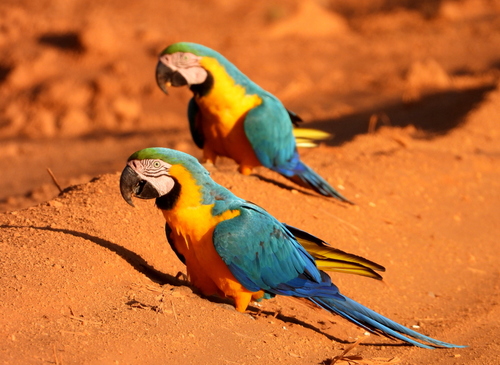
These macaws have vivid, distinct coloration: bright aqua blue feathers cover most of their upper body, while the head is lime colored.
Underside Coloration
The underside of their body is a rich deep yellow or light orange.
Beak and Foot Features
Their beak and the feathers under their chin are black. Their feet are gray, with black talons.
Facial Markings
They have white bare skin on the face; the face has almost no feathers except for a small number of spaced-apart black feathers that form a striped pattern around the eyes.
Eye Features
Their irises are pale light yellow.
Plumage Variation
There is very little plumage variation across the species' entire range. Some individuals have a more orange or butterscotch underside color, especially on the breast, a trait that was commonly seen in birds from Trinidad and other Caribbean populations.
Lifespan and Maturity
Blue-and-yellow macaws live 30 to 35 years in the wild, and reach sexual maturity between 3 and 6 years of age.
Beak Uses
They use their powerful beak to break open nutshells, and also to climb and hang from trees.
Diet
Their diet includes nuts, seeds, fruits, vegetable matter, bark, and leaves; insects and snails are reportedly eaten, but only rarely.
Native Range
This species is native to Panama, Trinidad and Tobago, Colombia, Venezuela, Guyana, Suriname, French Guiana, Ecuador, Peru, Brazil, Bolivia, and Paraguay.
Central America Distribution
Its range extends only slightly into Central America, where it is limited exclusively to Panama.
Urban Breeding Habitats
While most breeding populations occupy rural forested areas, small numbers do breed in urban settings: for example, in Rondonópolis, Mato Grosso, Brazil, they nest in dead ornamental palms planted alongside city roads.
Trinidad Population Decline
Human activity nearly wiped out the species in Trinidad during the 1970s.
Trinidad Reintroduction Program
A reintroduction program carried out between 1999 and 2003 translocated wild-caught blue-and-yellow macaws from Guyana to Trinidad, to reestablish the population in a protected area around the Nariva Swamp.
IUCN Trinidad Status
Despite the success of this program, the IUCN still lists the species as extirpated from Trinidad.
Introduced Populations
Small introduced breeding populations also exist outside the native range: one is established in Puerto Rico, and another has inhabited Miami-Dade County, Florida, since the mid-1980s.