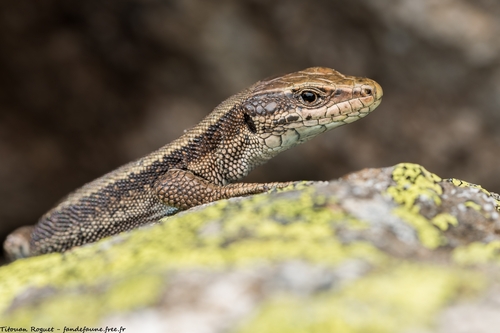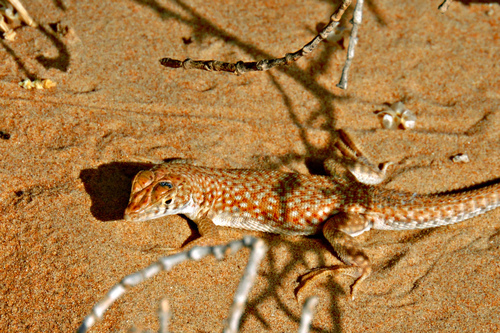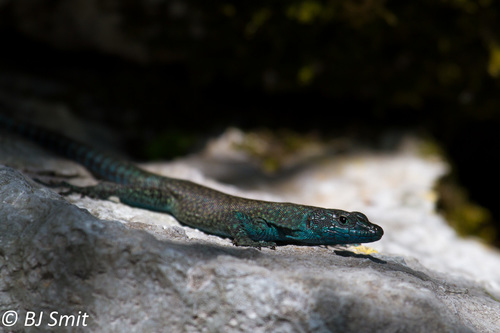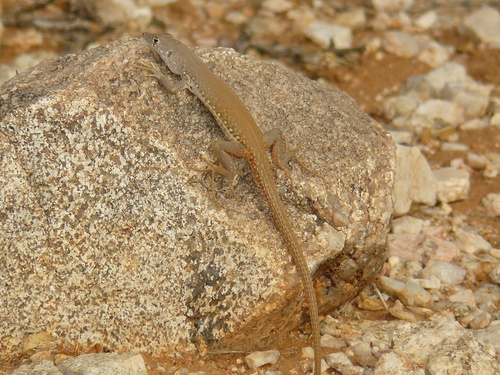
About Algyroides fitzingeri (Wiegmann, 1834)
Size and Body Form
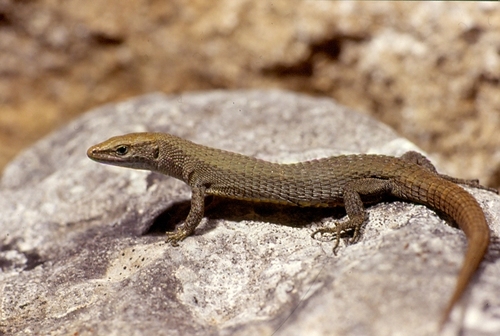
Fitzinger's algyroides, scientifically known as Algyroides fitzingeri, reaches a maximum total length of 130 mm, making it the smallest and most slender species in the genus Algyroides.
Dorsal Scale Trait
Like the Greek algyroides, this species has uniformly similar scales across its back, but it can be told apart from the Greek algyroides by several key traits: it has a sharp demarcation between the scales on its sides and underside, it lacks pale lines above the eye, and its hind legs are shorter than those of the Greek algyroides.
Flank Scale Distinction
It can be distinguished from the two other recognized Algyroides species—the Spanish algyroides and the blue-throated keeled lizard—by its unreduced flank scales.
Head Structure
The head of Fitzinger's algyroides is flattened, with a reduced layer of osteoderms.
Cranial Osteology Traits
Its supraciliary laminae are only partly ossified, and there are no teeth present on the pterygoid.
Hemipenis Morphology
This species is the only member of the genus Algyroides known to have a hemipenis with epithelium on the crown; all other Algyroides species have hemipenes with simple extended tips.
Endemic Range
Algyroides fitzingeri is endemic to Corsica and Sardinia, where it is found nowhere else.
Habitat Types
Its natural habitats include temperate forests, temperate shrubland, Mediterranean-type shrubby vegetation, temperate grassland, rocky areas, arable land, pastureland, and rural gardens.
Altitudinal Range
It occurs at altitudes ranging from sea level up to 1,800 m, or 5,900 ft.
Reproduction
This lizard is oviparous, and females produce clutches of 2 to 4 eggs.