About Dalmatolacerta oxycephala (Schlegel, 1839)
General Morphology
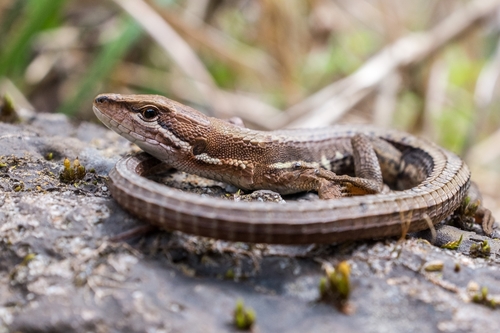
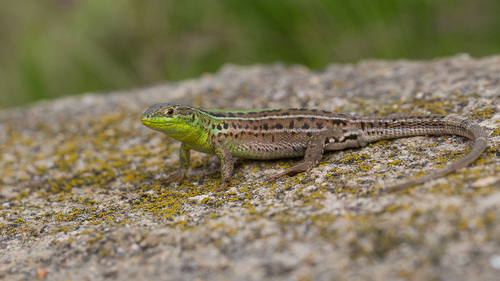
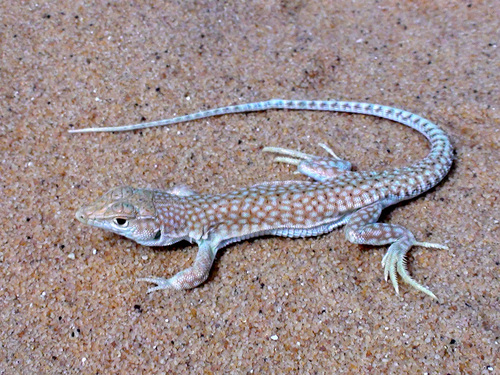
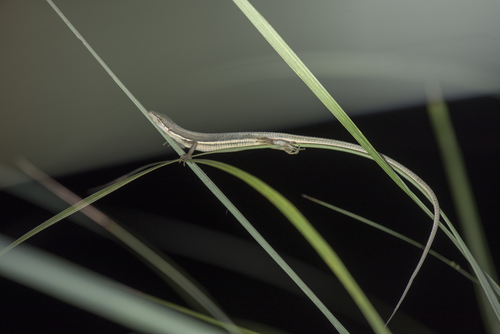
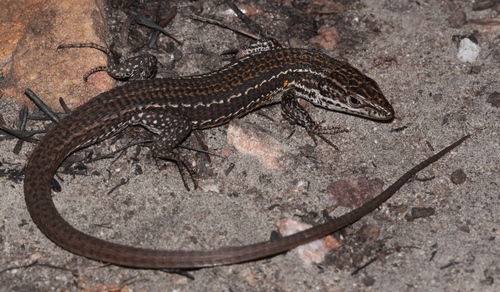
The sharp-snouted rock lizard (Dalmatolacerta oxycephala) is a slender, flattened lizard with a pointed snout and somewhat bulging eyes.
Adult individuals reach a maximum snout-to-vent length of 6.5 cm (2.6 in), and their tails are one and a half to twice as long as their bodies.
Hind Toe Features
Its hind toes are kinked, and shorter than the hind toes of other species in the same genus.
Subcaudal Scales
A second distinctive feature of this species is the wide central pair of scales located under its tail.
Colour Morph Overview
There are two main colour morphs of the sharp-snouted rock lizard.
Lowland Colouration
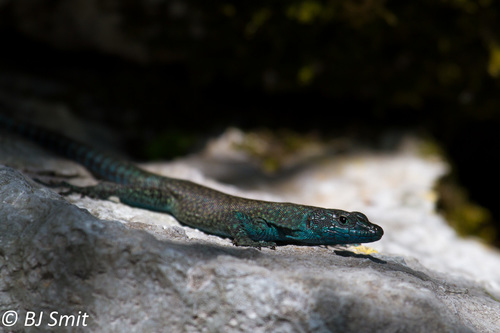
In lowland regions, individuals have a greyish-buff body with a brown reticulated pattern, and a tail marked with bold transverse black and turquoise-green stripes.
Upland Colouration
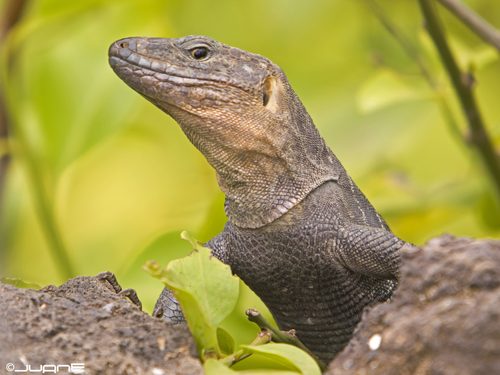
In upland areas and on some offshore islands, lizards are much darker, sometimes completely black.
Intermediate Altitude Colouration
Lizards from intermediate altitudes have variable colouration.
Underside Colouration
In all colour forms, the underside is blue, with males having a more intense blue colour.
Seasonal Colour Change
Some individuals change colour throughout the year, becoming darker during colder weather.
Juvenile Colouration
Juveniles have the same colouring as lowland adult lizards, but their tail stripes are more vivid.
Species Distribution
The sharp-snouted rock lizard is endemic to the territory of the former Yugoslavia, and may also occur in part of Albania.
Habitat Preferences
It inhabits rocky environments, including cliffs, boulders, rock pavements, stone walls, stone piles, and buildings; it is sometimes found on tree trunks, and occurs at altitudes up to 1,500 metres (4,900 ft).
Climbing Ability
It is a skilled climber, and is often seen 20 to 30 metres (67 to 100 ft) high on walls and roofs.
Camouflage Adaptations
The light-coloured morph is well camouflaged against the local limestone rocks, while the dark morph also blends into its background because local cliffs have deep fissures that grow dark-coloured moss.