About Aglaiocercus kingii (R.Lesson, 1832)
Species Identification
This species is the long-tailed sylph, with the scientific name Aglaiocercus kingii (R.Lesson, 1832).
Male Size
Males of the species are 16 to 19 cm (6.3 to 7.5 in) long including their 12 cm (4.7 in) outer tail feathers, and weigh 5 to 6 g (0.18 to 0.21 oz).
Female Size
Females are 9.7 to 11.7 cm (3.8 to 4.6 in) long and weigh 4.5 to 4.7 g (0.16 to 0.17 oz).
Bill Characteristics
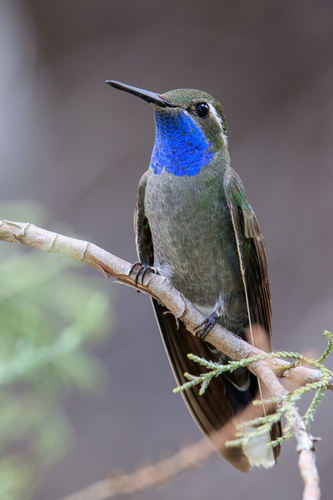
All subspecies of Aglaiocercus kingii have a short black bill.
Nominate Male Plumage
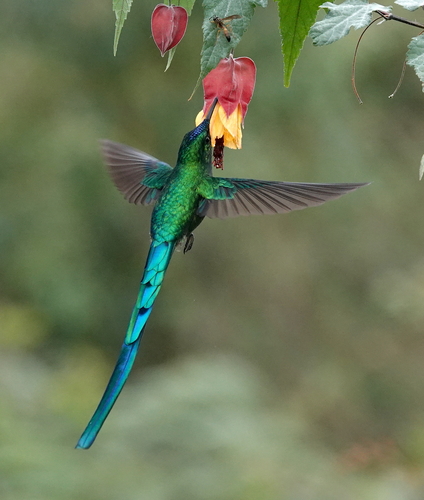
For the nominate subspecies A. k. kingii, males have a shining emerald green crown, metallic bronzy green upperparts, duller green underparts with an olive cast, and a blue or violet throat.
Nominate Male Tail Structure
The inner tail feathers are very short, while the outer tail feathers are very long.
Tail Length Comparison
Despite the species' English common name, its tail is not noticeably longer than the tails of other sylph species.
Nominate Male Tail Coloration
The upper surface of the tail is iridescent blue, green, and violet, and the underside is bluish black.
Nominate Female Upperparts
The upperparts of nominate subspecies females are similar to those of nominate males.
Nominate Female Tail Characteristics
Females have a short, somewhat forked tail, with dark blue outer feathers that have broad white tips.
Nominate Female Head and Throat
The female head is metallic green, with a white malar stripe and a white to buffy throat marked with green speckles.
Nominate Female Underparts
Female underparts are cinnamon.
Subspecies A. k. margarethae Traits
Subspecies A. k. margarethae males have paler green upperparts than the nominate subspecies, while females of this subspecies are similar to nominate females.
Subspecies A. k. caudatus Traits
Subspecies A. k. caudatus males do not have the blue throat that the nominate subspecies has, and its females are also similar to nominate females.
Subspecies A. k. emmae Bill Trait
Subspecies A. k. emmae has a somewhat longer bill than the nominate subspecies.
Subspecies A. k. emmae Plumage
A. k. emmae males are a paler and duller green and have a bright green throat; A. k. emmae females have more green spots on a white throat.
Subspecies A. k. mocoa Traits
Subspecies A. k. mocoa has shinier green upperparts than the nominate, and a sapphire blue to purple throat. Its female is similar to the nominate female.
Subspecies A. k. smaragdinus Male Trait
Subspecies A. k. smaragdinus has a shorter tail than the nominate and a greenish blue throat.
Subspecies A. k. smaragdinus Female Traits
A. k. smaragdinus females have bronzy green upperparts, a more bluish green crown than the nominate, and a chestnut wash on the back.
Subspecies Distribution
The subspecies of long-tailed sylph have the following distributions: A. k. margarethae is found in north central and coastal Venezuela; A. k. caudatus is found in western Venezuela's Serranía del Perijá and the Andes extending into northern Colombia; A. k. emmae is found in the northern Central and southern Western Andes of Colombia, south into northwestern Ecuador; A. k. kingii (nominate) is found in the Eastern Andes of Colombia; A. k. mocoa is found from the southern Central Andes of Colombia through Ecuador into northern Peru; A. k. smaragdinus is found in the eastern Andes of Peru, south into west-central Bolivia.
Habitat Types
The long-tailed sylph generally inhabits open landscapes including scrublands, clearings, forest edges, gardens, secondary forest, and high-elevation grassland.
Elevation Range
It occurs at elevations ranging between 900 and 3,000 m (3,000 and 9,800 ft).