About Lampornis clemenciae (R.Lesson, 1830)
Common Name and U.S. Size Status
Lampornis clemenciae, commonly called the blue-throated mountaingem, is the largest hummingbird found in the United States.
Length Measurement
It measures 11.2 to 12.8 cm (4.4 to 5.0 in) in length.
Weight by Sex
Males have an average weight of 8.4 g (0.30 oz), while females average 6.8 g (0.24 oz).
Bill Characteristics
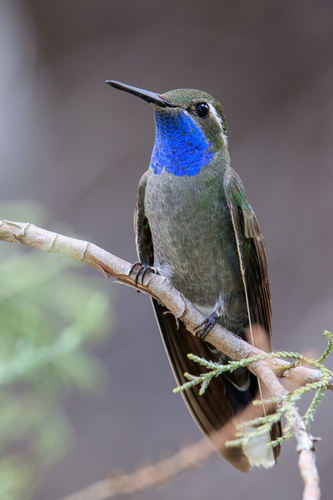
Both sexes have a medium-length black bill, with some variation across subspecies, and females have longer bills than males.
Facial Markings
All subspecies of both sexes have a noticeable white stripe behind the eye, plus a narrower stripe that extends backward from the corner of the bill, underneath a blackish cheek patch.
Nominate Subspecies Size and Bill Trait
The nominate subspecies is the largest and has the longest bill.
Nominate Male Gorget
Adult males of the nominate subspecies have an iridescent cobalt to cerulean blue gorget with a narrow buffy gray edge.
Nominate Male Upperparts
Their upperparts are mostly bright greenish bronze, becoming dark bronzy olive on the rump.
Nominate Male Underparts
Their underparts are medium brownish gray, with some greenish bronze iridescence on the sides of the breast.
Nominate Male Tail Traits
The tail is black with faint indigo iridescence and white tips on the outer two pairs of feathers.
Nominate Female Plumage
Females lack the gorget and have entirely medium gray underparts.
L. c. phasmorus Size and Bill Trait
Subspecies L. c. phasmorus is the smallest and has the shortest bill.
L. c. phasmorus Upperparts
Its upperparts are bright green rather than greenish bronze.
L. c. phasmorus Underparts by Sex
Males of this subspecies have cold gray rather than brownish gray underparts, while females have dark gray underparts.
L. c. phasmorus Breast Iridescence
The iridescence on the sides of the breast is green.
L. c. phasmorus Tail Trait
The white tips on its tail feathers are wider than those of the nominate subspecies.
L. c. bessophilus Size
Subspecies L. c. bessophilus falls between the other two subspecies in size.
L. c. bessophilus Upperparts
Its upperparts are duller than the nominate's, with less bronze mixed into the green.
L. c. bessophilus Underparts and Iridescence
Males have brownish gray underparts and females have medium pale gray underparts; like the nominate, it has some greenish bronze iridescence on the sides of the breast.
L. c. bessophilus Tail Trait
The white tips on its tail feathers are the narrowest of all three subspecies.
Nominate Subspecies Distribution Range
The nominate subspecies of blue-throated mountaingem has the largest distribution range.
Nominate Subspecies Geographic Occurrence
It occurs in Mexico's Sierra Madre Oriental and central plateau, extending as far south as Oaxaca.
L. c. bessophilus Distribution
L. c. bessophilus is found in southeastern Arizona and the northwestern Mexican states of Sonora, Chihuahua, and Durango.
L. c. phasmorus Confirmed Range
L. c. phasmorus is confirmed to live only in the Chisos Mountains of southern Texas, where it breeds, and its non-breeding range has not been documented.
Potential L. c. phasmorus Range
Birds in the northern Mexican state of Nuevo León may also belong to this subspecies rather than the nominate.
General Habitat Type
The blue-throated mountaingem inhabits a variety of moist forest landscapes.
Northern Range Habitat
In the United States and northern Mexico, it lives in riparian forest (often in canyons), pine-oak forest, and mixed coniferous forests.
Central and Southern Mexico Habitat
In central and southern Mexico, it tends to prefer coniferous forests.
Arizona Elevation Range
In Arizona, it is found in "sky island" mountain ranges, and it rarely occurs below 1,300 m (4,300 ft) in elevation.
Mexico Elevation Ranges
Near Mexico City, it occurs between 3,600 and 3,900 m (11,800 and 12,800 ft), and in Oaxaca it occurs between 2,500 and 3,000 m (8,200 and 9,800 ft).