About Acris crepitans Baird, 1854
Scientific Name
Acris crepitans Baird, 1854, commonly called the northern cricket frog.
Description
Size and Basic Traits
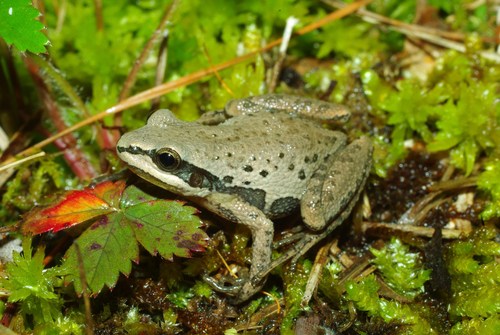
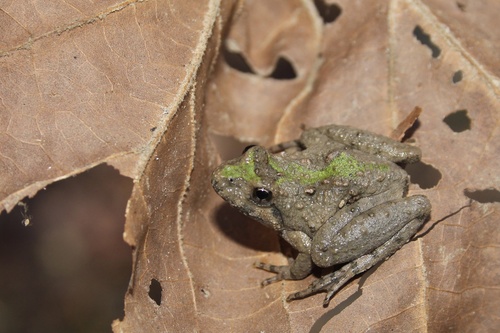
The northern cricket frog is one of the three smallest vertebrates in North America, with a body length ranging from 19–38 mm (0.75–1.50 in). It has a prominent blunt snout, bumpy textured skin, and no toe pads.
Dorsal Coloration and Markings
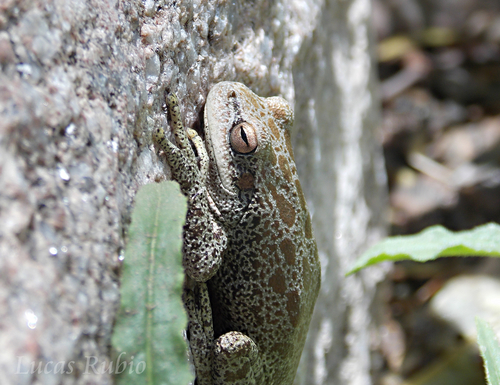
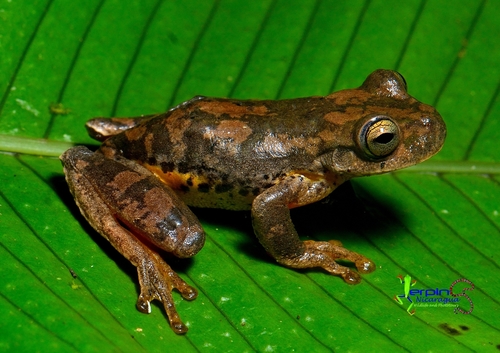
Its dorsal coloration varies widely, including grays, greens, and browns, often with irregular blotching patterns. There is usually a distinct triangular mark on its head between the eyes.
Color and Pattern Morphs
Dorsal stripes do not appear until after metamorphosis, and vary in brightness and hue. A biologist from New York has identified six distinct color morphs, four pattern morphs, and several intergrades between these groups.
Additional Body Markings
Typically, this species has dark banding on the legs and a white bar extending from the eye to the base of the foreleg.
Southern Cricket Frog Comparison
It is very similar to the southern cricket frog, Acris gryllus, which is found in the US Southeastern Coastal Plain, with their ranges overlapping along the Fall Line.
Morphological Differences
Compared to the northern cricket frog, the southern cricket frog has longer legs, less webbing on the hind feet, and a more pointed snout, though northern cricket frogs have been observed with snouts indistinguishable from the southern species.
Thigh Marking Variation
Markings on the back of the thigh are typically more sharply defined in southern cricket frogs than in northern cricket frogs, though biologists have recorded northern cricket frogs at the northern fringes of their range that have extremely sharp posterior leg stripes.
Annual Activity Pattern
This frog is active through most of the year; activity decreases significantly in December and resumes around mid-March.
Morphology
Hylid Distinguishing Traits
Acris crepitans are morphologically unique among hylids due to their unusually small size and bumpy skin, which is not commonly seen in the Hylidae family.
Sexual Size Dimorphism
Sexual maturity is reached when snout-vent length reaches 20mm. Females are slightly larger than males, and can reach a maximum snout-vent length of 38mm.
Miniaturization Evidence
The overall small size and limited skull ossification of the northern cricket frog suggests this species has undergone miniaturization — that is, the evolution of a smaller body size via changes to anatomy, physiology, life history, and behavior over time.
Miniaturization Driver
The need to reach sexual maturity rapidly could explain this species' miniaturization; these frogs grow 12 to 26 mm within a few months in preparation for the breeding season.
Cranial Structural Features
The cranial cartilages of adult northern cricket frogs are heavily mineralized with calcium to reinforce the cartilage as the frog develops. This species has small, thin, long, triangle-shaped nasals, which is consistent with being a small anuran.
Skeletal Variations
Other observed skeletal variations in A. crepitans include lateral asymmetry in the development of vomerine teeth and parasphenoid alae, and tumor-like growths on the femur.
Variation Hypotheses
Several hypotheses have been proposed to explain these observed variations: small skeletal malformations are naturally present at a high rate in this species; the malformations are caused by stress from habitat fragmentation; or they are caused by environmental contamination.
Habitat and distribution
Preferred Adult Habitats
Northern cricket frogs prefer the edges of slow-moving, permanent bodies of water, and favor open, shallow water with abundant aquatic vegetation. Adults live in temperate environments, while tadpoles live in shallow freshwater habitats with variable temperatures.
Group Clustering Behavior
Large groups can often be found clustered together along the muddy banks of shallow streams, especially during pre-migratory clustering.
Hibernation Habitat
Northern cricket frogs have been observed hibernating in upland areas, often at considerable distances from water.
Microhabitat Selection Factors
Temperature, proximity to water, shelter accessibility, and other factors influence this species' microhabitat selection.
For subspecies distribution
A. c. crepitans is found from New York south to Florida, and west along the Gulf Coast states to Texas. A. c. paludicola occurs from southwestern Louisiana to East Texas.
Immunology and reproduction allocation
Resource Allocation Background
Metabolic resources are allocated to different physiological systems, and the level of allocation can change with shifting external conditions and resulting internal demands. A great deal of research has studied the balance of resource allocation between immunity and reproduction, including research on Acris crepitans.
Immune Challenge Experiment
Male northern cricket frogs collected at the peak of the breeding season were injected with sheep blood cells to elicit an immune response. Researchers found that spermatic cyst diameter, germinal epithelium depth, and gonadosomatic index were all smaller in the immune-challenged injected males compared to saline-injected control males and non-injected males.
Experiment Conclusions
This indicates sperm production decreases under immunological stress. More broadly, these results demonstrate that when more resources must be allocated to the immune system under immunological challenge, resource investment in reproduction decreases.