About Abronia fragrans Nutt. ex Hook.
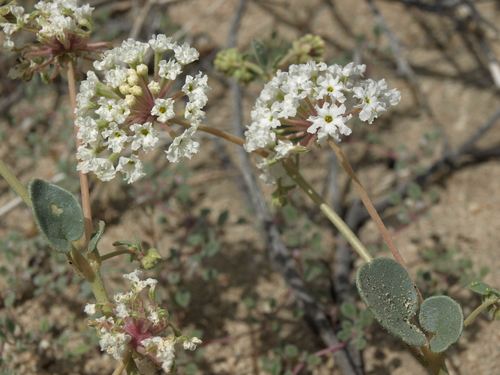
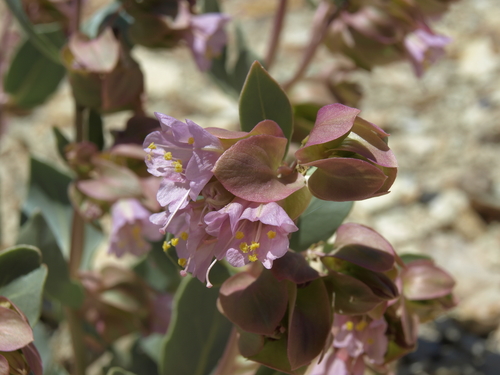
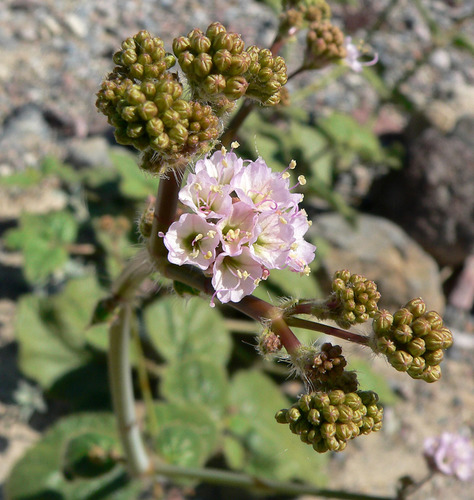
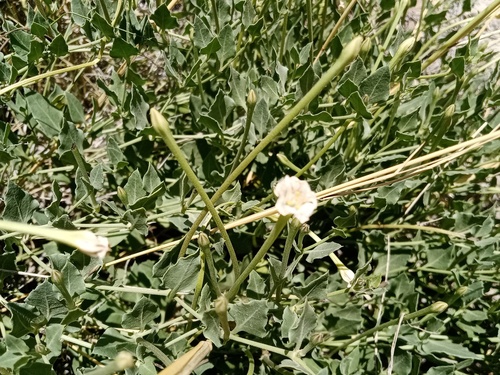
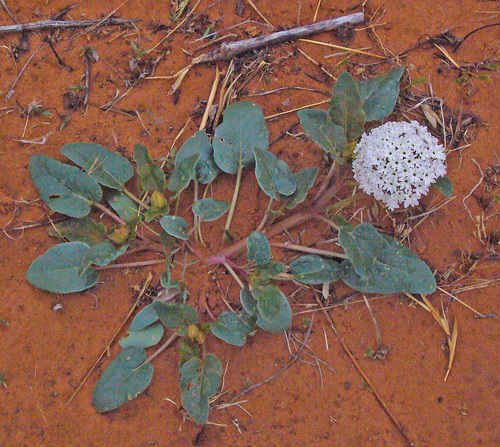
Abronia fragrans Nutt. ex Hook., commonly known as sweet sand-verbena, is an herbaceous perennial plant with an upright or sprawling growth habit. It reaches a height of 8–40 inches (about 20–102 cm), growing from a taproot, with sticky, hairy stems that measure 7.1 inches to 3.3 feet (18–100 cm) in length. Its flowers are held in clusters of 25 to 80 at stem ends; each flower has 4 to 5 petaloid sepals, sepaloid bracts, and a tubular corolla. Blossoms are typically white, but may have green, lavender, or pink tints. Across most of its native range, blossoms are solid pure white, but in southern parts of the range they sometimes develop a faint lavender-pink blush. Its leaves are sticky, simple, and grow in opposite arrangements. They can be up to 3.5 in (8.9 cm) long and 1.2 in (3.0 cm) wide, and are elliptical or linear in shape. Fruits are egg-shaped achenes about 0.1 in (0.25 cm) long, with a lustrous texture and black or brown color. Each achene is enclosed within a leathery, top-shaped calyx base that may or may not be winged. Flowers of this plant open in the evening and close again in the morning, which is the habit that gives the Nyctaginaceae plant family its common name of four o' clocks. Flowering occurs irregularly from June through late fall. The native range of sweet sand-verbena stretches from Northern Arizona to western Texas and Oklahoma, extending north through the Rocky Mountain and western plains regions of the United States, and south to Chihuahua, Mexico. It grows in prairies, plains, and savannas, most often in loose, dry, sandy soils. It is cultivated in gardens for its attractive, fragrant blossoms, and to attract butterflies. In garden cultivation, it has less strict soil requirements than it does in wild habitats. Indigenous peoples of the American Southwest use this plant for a variety of purposes. It is used as a wash for sores and insect bites, to treat stomachache, and as an appetite booster. The Navajo use it medicinally for boils, and take it internally when a spider has been swallowed. The Kayenta Navajo use it as a cathartic, for insect bites, as a sudorific, as an emetic, for stomach cramps, and as a general panacea. The Ramah Navajo use it as a lotion for sores or sore mouth, and to bathe perspiring feet. The Keres people mix ground roots of the plant with corn flour, eating the mixture to gain weight; they also use this mixture to avoid becoming greedy, and make ceremonial necklaces from the plant. The Ute use both the roots and flowers for stomach and bowel issues, while the Zuni use only fresh flowers for stomachaches. The Acoma and Laguna peoples mix ground roots with cornmeal and eat the mixture as food.