About Abronia latifolia Eschsch.
Taxonomy and Common Names
Abronia latifolia Eschsch. (also called Abronia arenaria) is a perennial sand-verbena species, commonly known as coastal sand-verbena or yellow sand-verbena.
Native Distribution
It is native to the west coast of North America, ranging from southern California to southern British Columbia.
Canadian Conservation Status
In Canada, this species is at risk of extirpation, or is classified as threatened or endangered.
Inflorescence Appearance
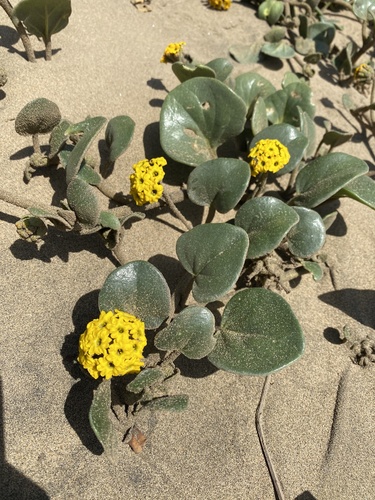
This plant produces attractive, neatly rounded heads of small, bright golden flowers.
Individual Flower Structure
Individual flowers have no petals; instead, yellow bracts form a trumpet-shaped calyx around the stamens.
Fruit Characteristics
It produces a small, winged fruit.
Growth Form and Habitat Substrate
Abronia latifolia grows in succulent mats on sand or other coastal substrates.
Root Morphology
Its roots are stout and fusiform, and often reach several feet in length.
Traditional Human Uses
These roots are edible, and were traditionally eaten by the Chinookan peoples.
Anti-herbivore Adaptation
This species displays psammophory, an anti-herbivore adaptation where sand adheres to the plant's body to make it harder for herbivores to eat.
Environmental Requirements
It requires salt water rather than fresh water, and cannot tolerate extreme drought.